Alex Ovchinnikov
We continue to compile the most important news, events and analysis on the environmental consequences of Russia’s war in Ukraine. We welcome your feedback—share as a comment on уыёthis post, email editor@uwecworkgroup.info, or contact us on social media.
UAnimals calls for a nationwide hunting ban during the war
Together with other civil society organizations and activists, the Ukrainian animal welfare organization appealed to the Cabinet of Ministers and the Ministry of Economy, Environment and Agriculture of Ukraine. Despite the fact that hunting is officially prohibited under martial law, animals continue to be killed under the guise of “sanitary culling.” Signatory organizations are calling for a complete ban on the killing of wild animals for any reason during the war.
The war has already inflicted colossal damage on Ukraine’s natural environment—estimated at 6 trillion hryvnias ($134 million) as of December 2025. Against this backdrop, killing animals for trophies or entertainment is barbaric. Yet the practice continues, with both wild and domesticated species being killed.
Over a two-month period in 2025 in Ternopil region alone, four wolves, 207 foxes, 259 dogs and 24 cats were killed. Animal welfare organizations describe the more humane and modern methods that are available for addressing public health issues, including oral vaccination and early disease detection systems. As animal rights activists point out, “sanitary culling” is often a cover for legalized killing of wild and stray animals.
Ukrainian actress and TV host Olga Sumska, Honored Artist of Ukraine, decried these practices, saying“Every day we see Ukrainians risking their own lives to save dogs, cats, horses, cows, birds and wild animals. Soldiers at their posts feed and rescue them, while volunteers travel hundreds of kilometers to give the animals a crack at survival. Against this backdrop, hunting strikes me as a completely barbaric practice. I want to live in a country where life is valued and humanity is the norm.”
The Association of Animal Welfare Organizations of Ukraine, URSA Animal Rights, as well as cultural figures, military personnel, members of parliament, and other opinion leaders, including singers Jerry Heil and alyona alyona, actresses Olga Sumska, Irma Vitovska-Vantsa and Anna Koshmal, ONUKA frontwoman Natalia Zhizhchenko, stand-up comedian and volunteer Vasyl Baidak, military servicemember Masi Nayem, TV host Oleksiy Sukhanov and writers Maksym and Tetyana Kidruk joined UAnimals in the appeal.
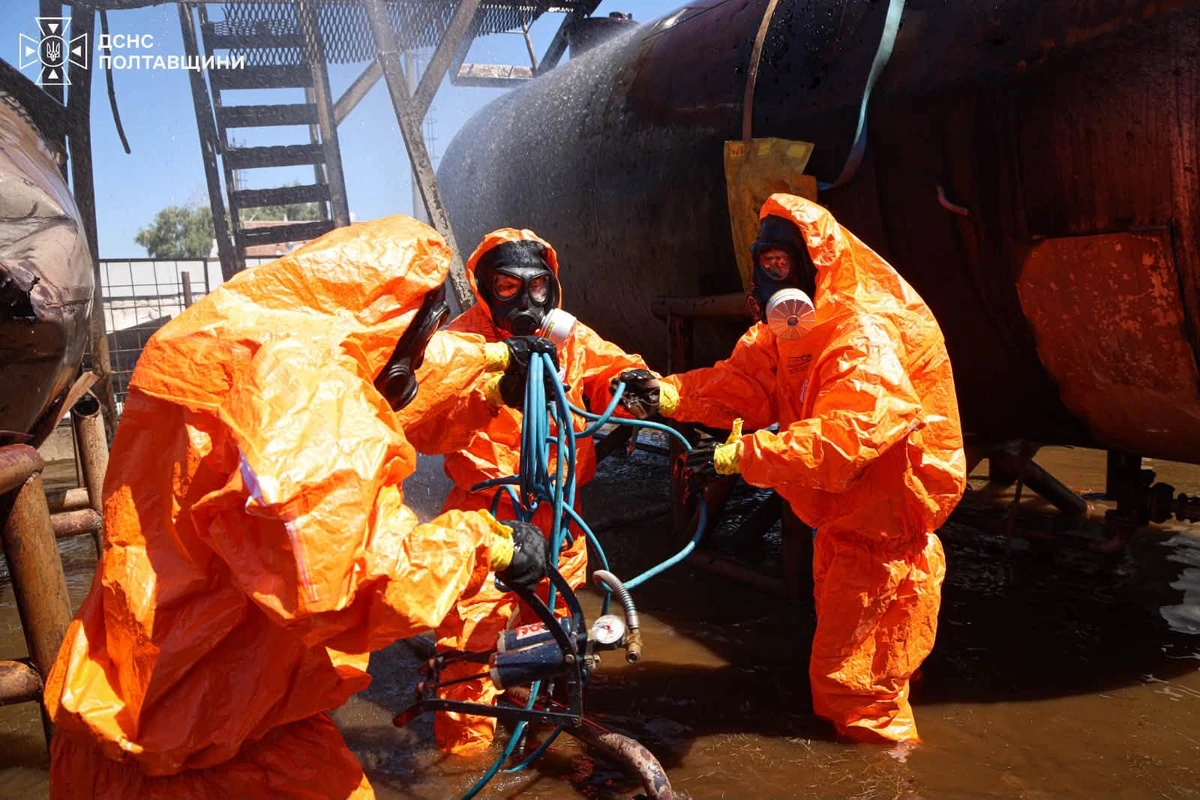
New environmental consequences of Russia’s war in Ukraine: Fires in Askania Nova Nature Reserve, destruction of the channel near Syvash and chemical contamination in the Poltava region
According to the Ukrainian environmental media outlet EcoRayon, a July satellite analysis showed that after the Ukrainian Armed Forces (UAF) destroyed a bridge crossing the Promoina Strait in Syvash, the Russians began filling the strait with earth to allow military equipment to pass between Henichesk and the Arabat Spit. As a result, one of the two natural water bodies connecting the Syvash and the Sea of Azov is now at risk of being destroyed.
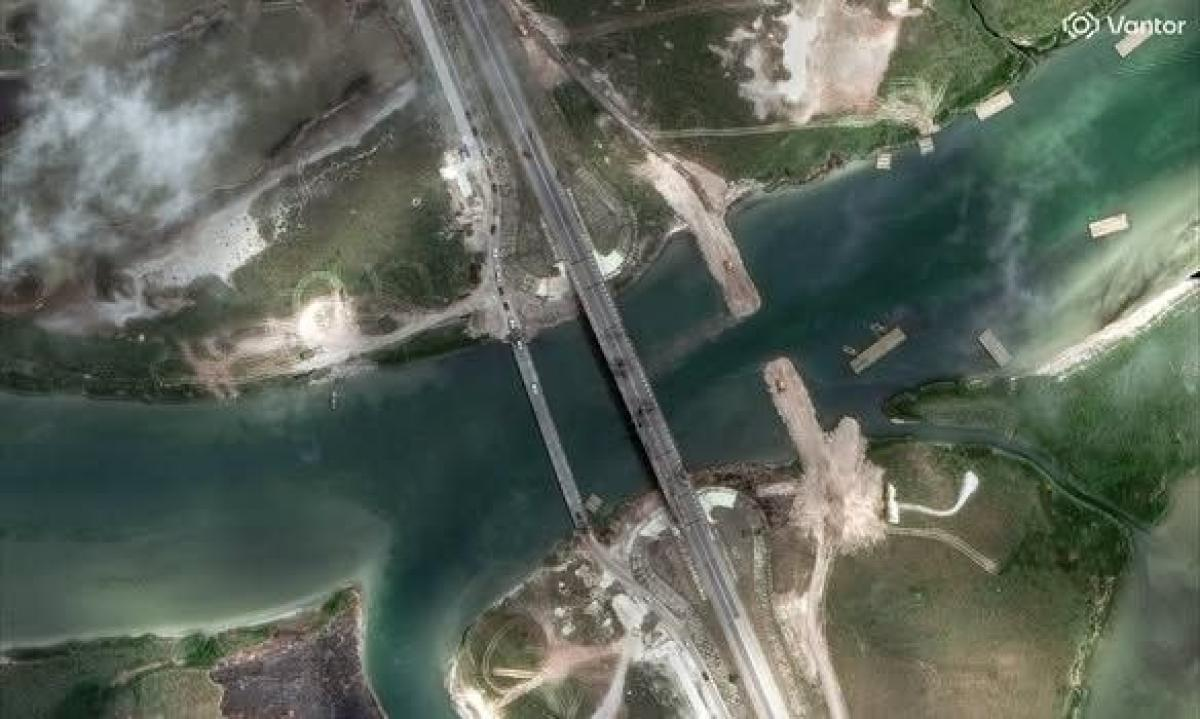
The Syvash waters are a unique system of shallow bays, lagoons and water channels, critical habitat for wildlife. This system forms the western border of the Azov Sea and northeastern Crimea. Its natural water circulation is wind-driven and occurs through two water channels—the Tonkaya and Promoina. A northeasterly wind drives water from the Utlyuk Estuary toward Syvash, while a westerly wind drives it back into the Sea of Azov. According to EcoRayon, the Tonkaya is wider and has been the main channel for many years, while Promoina formed after a storm in 1969. Nevertheless, blocking this bay will alter the water exchange that has developed in past decades, changes which could lead to the formation of stagnant zones and affect local fauna—especially the populations of small crustaceans that are an important food source for fish and birds.
The Syvash is classified as a hypersaline water body and it is particularly sensitive to fluctuations, as water circulation directly determines whether life can exist there or not. When blocked, water will accumulate at the closure site, leading to active decomposition of organic matter, oxygen depletion and localized algal blooms. This can be particularly dangerous in the summer and when the region experiences abnormally high temperatures. Meanwhile, Tonkaya, the second strait suffers from both the war and climate change: in some areas, it is becoming shallower, and new channels and sedimentation zones are forming. All of this indicates that Syvash—not only a unique natural monument but also a crucial area for fish reproduction and a wintering ground for migratory birds—needs ecological protection and not military destruction at the present moment.
If the Syvash were to dry up or if its salinity were to increase sharply, it could lead to mass extinction of crustaceans, the populations of which have for centuries provided a stable food source for wintering birds. Syvash lakes are a key site for these migratory birds, and the area itself is listed as wetlands of international importance under the Ramsar Convention.
Amid ongoing military operations, the abnormal heatwave that struck Ukraine this past summer has also led to new forest fires. In particular, the Falz-Fein Askania Nova Biosphere Reserve has been particularly hard hit. According to Sentinel-2 satellite imaging published on the reserve’s Facebook page (in exile), a total of 3,149 hectares in the core zone were affected by fire between June 22 and July 23, 2026 as well as an additional 703 hectares in the buffer zone.
Askania Nova Reserve was originally established to protect 11,064 hectares of virgin steppe that has never been plowed. This means that more than a quarter of the reserve’s total area was damaged by fire this summer.
Like many other national parks and nature reserves that have come under Russian occupation, Askania Nova has suffered significantly over the years of full-scale war. In addition to forest fires and the occupying administration’s negligent treatment, part of the reserve’s unique wildlife population has also been sold off. Nevertheless, scientists continue to work remotely, outside the reserve, holding out hope that they will be able to return to Askania Nova.
Read more:
- Askania Nova Biosphere Reserve captured by invaders
- Fires in Askania-Nova: Consequences of military occupation of a reserve
- Russia selling off rare animals from Ukraine’s Askania-Nova nature reserve
- Ramsar wetlands under fire in Ukraine
Post-war restoration of steppe grasslands using natural methods
In collaboration with scientists from Askania-Nova Biosphere Reserve, the NGO Rewilding Ukraine (a branch of Rewilding Europe founded in 2011) launched a project for the natural postwar restoration of steppes, Living Steppes Are Sustainable Communities: Restoring Postwar Steppe Pastureland and Hayfields in Southern Ukraine.”
As noted in the project’s rationale, the Ukrainian steppes are among Europe’s most vulnerable ecosystems. Fighting caused by Russia’s full-scale invasion in the Kherson region has significantly damaged steppe grasslands. At the same time, Odesa region steppes are also threatened by pressure to develop new land for agricultural purposes.
The project will be implemented in the Velyka Oleksandrivka hromada in the Kherson region and the Budzhakska hromada in the Odesa region—home to the Budzhakska steppes, an area that extends across the border into Moldova. In modern Ukraine, a hromada is an administrative-territorial unit that brings together local residents to address specific issues. Following Ukrainian decentralization reforms in 2014, these entities have become the primary local decision-making body.
The project plans to use nature-based restoration methods, specifically by transplanting sod and hay containing seeds of local steppe plant species and reseeding native species, with subsequent long-term monitoring of the results. There are also plans to compare the restoration process in damaged areas with natural processes in Tarutynska Steppe Landscape Reserve ecosystems. Rewilding Ukraine has been working on steppe ecosystem restoration in this reserve in collaboration with scientists from Askania-Nova for the past five years.
As the project organizers note, ecosystem restoration means not only restoring biodiversity but also improving soil health, increasing landscape resilience to drought and supporting traditional forms of land use, such as livestock grazing, hay harvesting and beekeeping, all of which benefit both nature and local communities.
Ukrainian environmental organizations are calling for the reinstatement of the Ministry of Environmental Protection
Ukrainian organization “Environment.People.Law” (EPL) is calling for the reinstatement of Ukraine’s environmental ministry. Their advocacy was prompted by recent changes in Ukraine’s system of government, specifically the creation of a separate Ministry of Agrarian Policy and Food of Ukraine.
As a reminder, in July 2025, the Cabinet of Ministers of Ukraine dissolved the Ministry of Environment and Natural Resources (Mindovkilla), merging it with the Ministry of Agrarian Policy and the Ministry of Economy to create the Ministry of Economy, Environment and Agriculture.
Today, environmental and nature conservation issues are still handled by the Ministry of Economy, Environment and Agriculture, a hierarchy which prevents the full implementation of environmental and nature conservation projects, fails to meet wartime environmental needs and does not contribute to Ukraine’s European integration.
As representatives of EPL note, Ukraine is currently experiencing the most catastrophic environmental crisis in its entire history as an independent nation, a crisis caused by Russia’s full-scale invasion. Ecosystem destruction, environmental pollution and the devastation and destruction of nature reserves create a series of environmental challenges that require appropriate solutions.
Equally important is the issue of European integration, under which Ukraine must implement approximately 200 environmental directives and regulations. That effort requires a strong and independent governing body—something a “dual-role” ministry cannot provide. Already today, EPL experts note significant pressure on staff, insufficient resources and difficulties in coordination. These problems are particularly acute when it comes to environmental protection, enforcement and oversight, as well as in assessing negative environmental impacts.
In addition, Russia is committing ecocide in Ukraine—sufficient staff and qualified specialists are needed today to document, assess and prosecute crimes against nature before national courts—and, in the future, before international courts as well.
EPL representatives note that Ukrainian organizations, activists and public figures have repeatedly appealed to the government to reestablish the dedicated Ministry of Environmental Protection and Natural Resources, but have received no response. The sooner this ministry is reestablished, the sooner the country can assess the environmental consequences of the full-scale invasion and develop plans for Ukraine’s sustainable and modern recovery.
Translated by Jennifer Castner
Main image: Spill cleanup efforts following an attack on critical infrastructure in the Poltava region. Source: Ukrainska Pravda