We continue to compile the most important news, events, and analysis on the environmental consequences of Russia’s war in Ukraine. We welcome your feedback—share by commenting on the article, emailing us at editor@uwecworkgroup.info, or contacting us via social media.
How the war has affected the Ukrainian steppe: new research
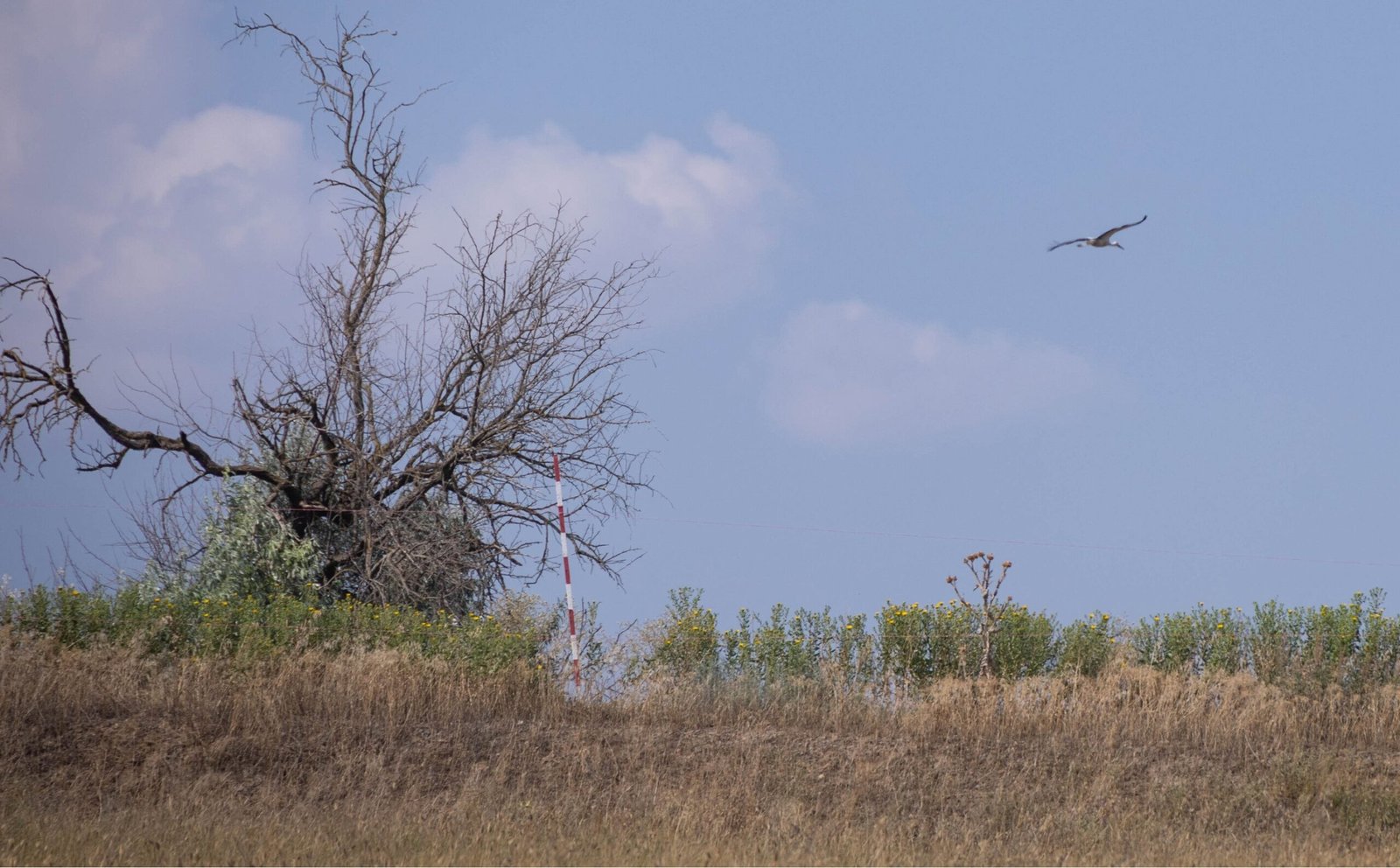
Scientists conducted another expedition to the Visunsk-Inhulets Regional Landscape Park on the border between the Mykolaiv and Kherson regions to study the war’s impact on the Ukrainian steppe. The Ukrainian media outlet Frontliner reported on the study’s findings.
The front line crossed this area in 2022, and it was from here that Ukraine’s counteroffensive on Kherson began. Consequently, part of the landscape park remains mined, with a large number of both craters left by explosions and unexploded munitions still present. It is still unsafe to conduct research there. Last year, the scientists set out on an expedition wearing body armor and carrying tourniquets.
As Aleksandr Khodosovtsev, a leading researcher at the M. H. Kholodny Institute of Botany, told a Frontliner correspondent, fierce battles took place within the park, leaving behind a large number of craters. This provides fertile ground upon which to study the war’s impact on steppe vegetation, determine how nature is recovering, and estimate the amount of time needed for recovery.
Their focus is specifically on better understanding the craters: researchers document them and note the species of plants that take root within them as well as those which grow around them. Foxes have already begun to settle in some of the craters, digging burrows.
Recording data for a single crater can take about two hours, after which the scientists move on to the next one. In a single day, two scientists can document vegetation recovery across four craters. The research will inform decisions about whether to leave the craters as they are or to fill them with soil to restore the steppe.
As the scientists note, one of the biodiversity issues caused by craters resulting from shelling is the spread of invasive species within them. An explosion destroys the existing vegetation cover, alters the soil’s chemical composition, and often contaminates it. Such areas are quickly taken over by plants with more aggressive adaptation strategies, as well as those that thrive in contaminated areas, such as vacant lots, fields and combat zones. For example, ragweed (Ambrosia ssp.) is actively displacing endemic steppe plants. Moreover, this occurs not only at crater sites but also along the routes taken by military vehicles—anywhere that vegetation and soil layers are disturbed. As biologist Ivan Moiseenko notes, this results in two distinct ecological zones: where the steppe has been preserved, we see biodiversity—for example, several species of feather grass (Stipa ssp.) may grow in a single area—while where military vehicles have passed or traces of explosions are visible, the territory is taken over by uniform weeds.
Ukrainian steppes are protected under international (European) environmental conservation standards. The areas that have not been converted to agricultural use demonstrate significant biological diversity—up to 100 different plant species can be found here per ten square kilometers. Mushrooms, lichens and moss-like plants also grow here, and there is a high diversity of insects and other animal species.
Among the species found here, there are quite a few endemic species, and new species are still being discovered. For example, in 2021, molecular genetic analysis confirmed the existence of a previously unknown species of lichen at Oleshky Sands National Park. Its species description and its scientific justification was not published until 2024. By that time, the lichen’s habitat had already been subjected to military occupation, movement of military equipment, and, possibly, flooding resulting from the Kakhovka Hydropower Plant (HPP) dam’s destruction. It is unknown whether the newly discovered species survives; its habitat remains under occupation.
In addition to the damage to natural diversity documented by research expeditions, cultural diversity is also under attack. The Ukrainian steppe is rich in artificial burial mounds dating to the times of the Scythians and other nomadic peoples. Today these mounds are treated as “strategic high ground”, where military command posts are established and dugouts built, and where firing positions and artillery are deployed. Military activity thus destroys Ukraine’s natural and historical heritage.
Significant damage also continues to be inflicted on Ukraine’s protected area system as well. For example, while scientists were still able to visit the Kamenska Sich National Park as recently as 2025, today its territory has been transformed into a kill zone (active combat area), rendering research impossible. According to researchers’ September 2025 estimates, the damage resulting from Russia’s full-scale invasion amounted to 190 billion hryvnias (more than 3.5 billion euros) for Kamenska Sich National Park alone. This estimate includes damage from numerous fires that have destroyed significant areas home to diverse flora and fauna, as well as the consequences of the destruction of the Kakhovka HPP dam, which led to massive fish kills. Although scientists have already prepared a plan to restore the steppe within the national park, it is impossible to begin implementing while hostilities continue.
Today, only 3–4% of the Ukrainian steppes—areas which once accounted for 40% of the country’s territory—remain. This was largely due to agricultural development that began even before the war. However, the full-scale Russian invasion dealt a devastating blow to the steppe region, which is located in southern and eastern Ukraine—the areas that suffered the most during the war. At the same time, the Ukrainian steppes are a habitat unique to Europe, as the vast Eurasian steppe begins right here—it does not exist in other countries.
Read more: Fighting for life: How Russia’s war in Ukraine threatens to wipe out rare species
Can nature heal war wounds? Klavdievsky Forest cast study
One way to restore biodiversity in areas contaminated by fortifications and military operations is to designate them as nature reserves and leave them undisturbed. One such example is the Klavdievsky Forest, located northwest of Kyiv and part of the capital’s greenbelt, a natural area that actively helped to halt Russia’s advance in 2022.
Klavdievsky Forest suffered significant damage during the first year of the full-scale invasion, when Russian paratroopers from Pskov built fortifications there, leaving behind a considerable amount of pollution. Nevertheless, a rare ecosystem of open woodlands has survived here. For this reason, scientists from the Ukrainian Nature Conservation Group propose establishing Dubina Nature Reserve to protect Klavdievsky Forest’s light-intensive thermophilic oak forests—a unique, open and heat-loving forest ecosystem. Botanist and Doctor of Biological Sciences Igor Moiseenko notes that the forest remains rich in rare Red Book species, for example the martagon lily (Lilium martagon) or the leafless iris (Iris aphylla), the latter of which is protected under the Bern Convention, as well as several species of rare orchids.
Russian fortifications cause serious damage to these forest ecosystems. As in the case of the steppes, pockets of invasive species began to form where the soil had been damaged. The area is rapidly being taken over by species such as Canadian fleabane (Erigeron canadensis), Canadian goldenrod (Solidago canadensis), ragweed (Ambrosia gen.), black cherry (Prunus serotina), and Syrian milkweed (Asclepias syriaca). They actively form dense, dark thickets, virtually destroying the light-forest ecosystems. Researchers note that caponiers and fortifications only contribute to the spread of weeds and the darkening of the forests, altering both ecological and soil conditions. Thus, any additional pressure—whether logging or construction—could push Klavdievsky Forest past the tipping point. Establishing a nature reserve will halt the destruction of the ecosystem and preserve these forests, which are unique to Ukraine.
Russian fortifications have caused serious damage to ecosystems. As with steppe habitats, pockets of invasive species began to form in areas where the soil had been damaged. The area is rapidly being taken over by species such as Canadian fleabane (Erigeron canadensis), Canadian goldenrod (Solidago canadensis), ragweed (Ambrosia gen.), black cherry (Prunus serotina), and Syrian milkweed (Asclepias syriaca). They actively form dense, dark thickets, virtually destroying the light-forest ecosystems. As scientists note, the caponiers and fortifications only contribute to the spread of weeds and the darkening of the forests, altering both ecological and soil conditions. Therefore, any additional pressure—whether logging or construction—could destroy the Klavdievsky Forest. Establishing a nature reserve will halt the destruction of the ecosystem and preserve these unique forests in Ukraine.
Repairing soil damage in wartime
On September 10, in the framework of the RECOVER project, World Wide Fund for Nature (WWF) held a meeting titled “Crop production in Ukraine amid war and European integration: from challenges to sustainable development.” According to the environmental news site EcoRayon, the event brought together representatives from the government, the agricultural sector, civil society, and international organizations. EcoRayon reported that the goal was to discuss and develop a strategy for restoring soils damaged during the war as part of Ukraine’s European integration process.
Many agricultural areas in Ukraine are currently mined; however, even after the demining process is complete, additional soil quality studies must be conducted to test for heavy metals and determine contamination levels. This information enables the Ukrainian agricultural sector to meet European Union standards and gain access to European markets.
WWF-Ukraine experts highlighted opportunities to use natural mechanisms for soil restoration. Nature-based remediation—such as planting specific crops, establishing fallow zones and moving away from intensive agriculture—can not only serve as a quick and effective way to restore soil but also bring Ukraine closer to meeting European standards on the path to European integration. Furthermore, this approach contributes to achieving climate adaptation goals in the agricultural sector, another means of accelerating European integration.
The RECOVER project is being implemented by WWF-Ukraine in partnership with Chalmers University of Technology (Sweden) and Taras Shevchenko National University of Kyiv. Its goal is to promote a climate-focused recovery of Ukrainian agriculture, which should enhance its competitiveness in European markets.
Launch: registry of damage caused by the Russian Federation’s aggression against Ukraine (RD4U)
Ukrainian environmental organization Ecology. People. Law. (EPL) announced that starting August 1, 2026, information can be submitted to this registry across 43 damage categories, including categories B3.1—Environmental Damage and B3.2—Theft or Misappropriation of Natural Resources.
Category B3.1 refers to any harmful impact resulting from hostilities on fauna, flora, soil, water, air and ecosystems. It includes claims related to harm caused specifically to the environment. Claims related to harm to persons and their property that have arisen or may result from damage to the environment, as well as claims regarding related humanitarian expenses or demining and clearance of unexploded ordnance, are filed under other categories.
Category B3.2 covers claims related to the theft of natural resources, i.e., the exploitation of natural resources for commercial gain.
One distinctive feature of the registry is that claims in these categories may be submitted by the State of Ukraine, central, regional and local authorities, and state and municipal institutions and organizations. However, Ukrainian legislation currently does not clearly specify which government agencies are responsible for submitting claims to the registry.
Read more: Environmental consequences of the war in Ukraine: September 2024 review
For its part, EPL calls on the government to expand the list of entities eligible to file claims. Specifically, it calls for the inclusion of nongovernmental organizations. To this end, a separate category—C5: Environmental Damage—could be created. For example, this category could allow landowners and land users whose properties have suffered as a result of the Russian military invasion and who have environmental protection obligations to file claims. In August 2026, EPL submitted a corresponding proposal to the Ministry of Economy (which also performs the functions of the Ministry of Environment and Natural Resources), however, as indicated in the response, the ministry does not consider it appropriate to engage in dialogue with the public on this issue, noting that this authority falls under the jurisdiction of the State Environmental Inspection of Ukraine (SEI).
Nevertheless, the SEI’s authority still does not include the obligation to document environmental damage caused by military actions. This gap prevents further claims being filed with international bodies to seek compensation for the aggressor’s damage. Currently, SEI representatives are only required to conduct an inspection (survey) of sites where environmental damage has occurred. However, as EPL experts note, inspectors often do not even visit the scene of the incident for security reasons, stating that an inspection is impossible without the de-occupation and demining of the territories. All of this creates the risk that the damage caused to Ukraine’s environment as a result of Russia’s armed aggression—which, according to the Ukrainian Ministry of Economy, is estimated at more than 6.4 trillion hryvnias—will simply not be fully compensated due to a lack of evidence.
Main image: A stork over the southern steppe. Vysunsk-Ingulets Regional Landscape Park, Mykolaiv Oblast, Ukraine, July 16, 2026. Source: Olena Maksymenko / Frontliner