Eugene Simonov and Oleksiy Vasyliuk
In the wake of the full-scale invasion in February 2022, the World Bank, alongside the Government of Ukraine, the European Commission, and the United Nations, shifted from traditional country strategies to a dynamic series of assessments. These core strategic documents, known as the Rapid Damage and Needs Assessments, integrate on an annual basis data on war damages and losses with the calculation of reconstruction needs. This article analyzes the key environmental aspects of this approach and its evolution and compares it with strategic recommendations issued by civil society groups to identify the gaps and biases that still prevent RDNA assessments from serving as a valid base for strategic environmental planning.
Why the assessment plan is shrinking and the implications for environmental safeguards
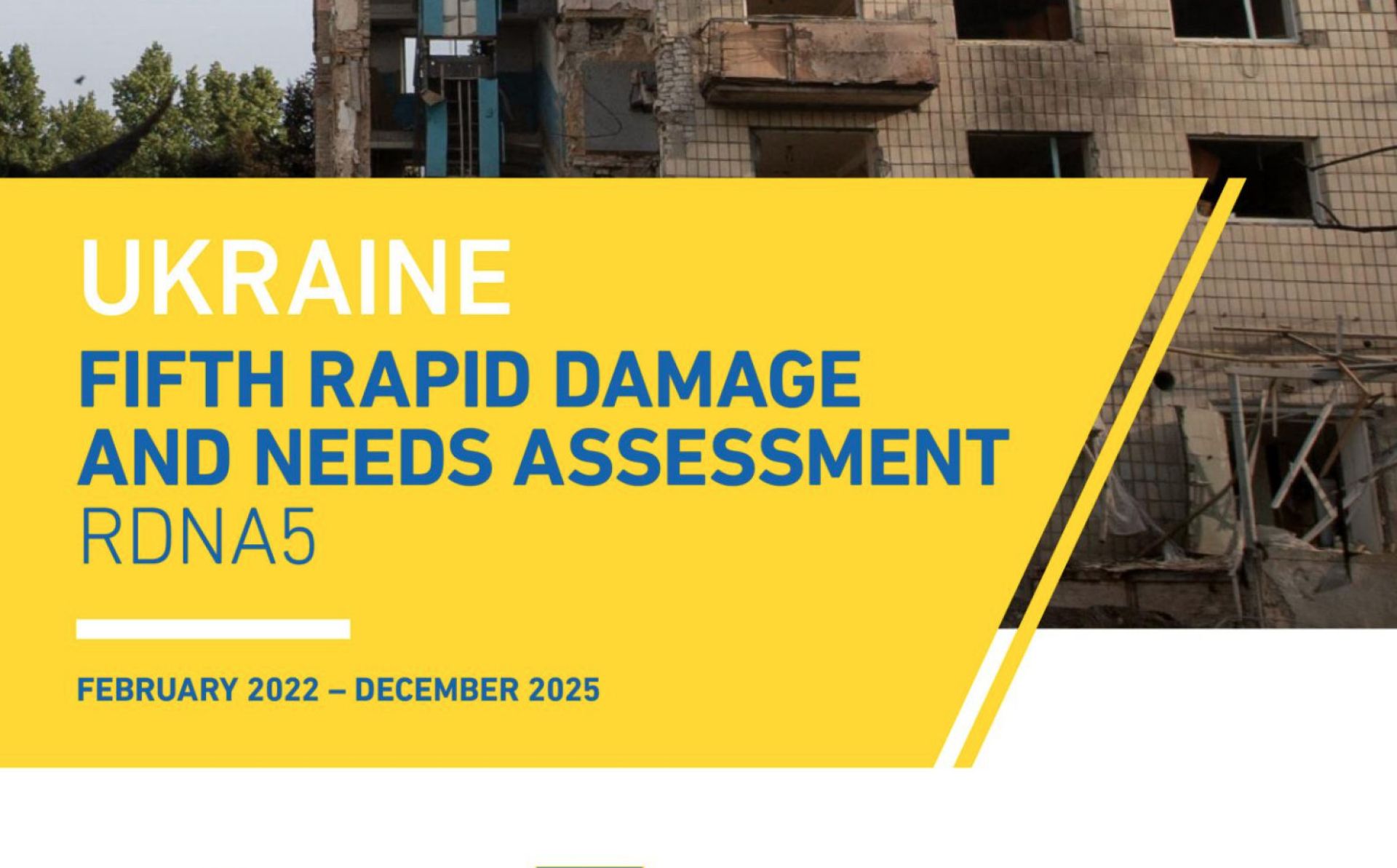
The fifth version of the Rapid Damage and Needs Assessments (RDNA5) is significantly shorter, dropping to just 63 pages compared to the nearly 200 pages of its predecessor. After four years of exhaustive, bottom up data collection, the authors actively chose to automate and extrapolate data for smaller economic sectors to save time and resources. Instead of writing deep dive chapters, they used sector-specific extrapolation rates based on previous trends and spatial conflict intensity data.
Because the frontlines in 2024 and 2025 remained relatively static compared to the massive territorial shifts of 2022, the types of damage are no longer novel. RDNA5 does not suggest new substantive ways to mitigate that damage and does not suggest new explanations of what “Build Back Better” should look like in practice. The document acts merely as a ledger update to existing datasets. Environmental and infrastructural data flow in Ukraine has also been severely degraded due to wartime policies, such as restricted access to public registries and a moratorium on state environmental inspections. The World Bank simply lacks the fresh, granular ground truth data required to write a highly detailed report.
Furthermore, the assessment reflects a strategic pivot by the international community. The primary bottleneck for Ukraine is no longer identifying what is broken, but building the bureaucratic machinery capable of absorbing billions of dollars. The focus has shifted to making projects “bankable” (safe for the banks pouring in international finance) and aligning them with the European Union Ukraine Facility.
Beginning with RDNA5, the RDNA process has reached a point of diminishing returns. The international community already knows the damage is catastrophic, nearing $600 billion. This latest report treats damage assessment as a routine bureaucratic update, deliberately trading granularity for efficiency so that limited human resources can focus on the actual implementation of recovery projects.
Marginalization of environmental protection in recovery planning
Across the assessments from 2023 to 2026, the World Bank methodology shifted slowly from a basic resource extraction mindset, primarily focused on forestry, toward a somewhat more holistic understanding of ecological impacts. Early reports ignored protected areas entirely. A major shift occurred following the catastrophic breach of the Kakhovka Dam in June 2023, prompting the fourth assessment to specifically name impacted protected areas and propose explicit funding for their rehabilitation. In 2026 however, the fifth assessment regressed, mentioning biodiversity only in a generalized statement regarding $36 billion in environmental losses.
Ecosystem restoration goals similarly evolved from traditional plantation forestry to incorporating nature-based solutions, but ultimately remained minor priorities. The latest assessment treats the loss of ecosystem services as a secondary need, allocating a mere $3.1 billion for forest restoration, pollution remediation and green jobs creation. National parks, grasslands and other conservation assets articulated in previous reports are completely absent in the latest version, as are the findings of government sponsored reports on restoration needs in Ramsar wetlands.
Read more: Ramsar wetlands under fire in Ukraine
Environmental and natural resource sectors remain a glaring blind spot in the recovery framework, making up less than one percent of the nearly $600 billion in total recovery and reconstruction needs. The assessments continually fail to recognize the full value of ecosystem services, reverting to a narrow focus on commercial forestry and basic pollution cleanup rather than comprehensive ecological restoration.
Clashing over safeguards for sustainable recovery
A roadmap for sustainable recovery authored by a coalition of NGOs sets forth clear principles for green reconstruction. While the RDNA assessments have progressively moved closer to this vision, significant gaps remain. Both the NGO and the World Bank frameworks agree on the necessity of aligning with the European Union acquis, the core set of legal requirements binding all EU member states, but their practical applications diverge sharply.
As an example, RDNA5 proposes $55.3 billion for the agricultural sector, focusing almost entirely on restoring pre-war production capacity, such as rebuilding old irrigation systems. Civil society groups warn that returning to these pre-war agricultural models is environmentally unsustainable, advocating instead for agro-ecological approaches and climate resilience. Furthermore, the RDNA assessments broadly group environmental damage under forestry and natural landscapes, entirely missing the destruction of meadows, steppes, and wetlands.
To prevent ecological destruction during rapid rebuilding of the economy, civil society demands the strict implementation of the European Union’s Do No Significant Harm principle and the formal codification of ecosystem services into Ukrainian law. In contrast, the RDNA assessments emphasize streamlining processes and rapid project implementation. NGOs highlight the extreme danger of trading environmental oversight for speed, pointing to the government practice of using experimental projects to bypass environmental impact assessments.
There is a fundamental conflict between the World Bank’s push for rapid, streamlined “capital absorption” and civil society demands for strict, legally-enforced ecological guardrails. While the official assessments treat accelerated reconstruction as an inherent good, environmental organizations warn that without enforcing the Do No Significant Harm principle and rigorous environmental impact assessments, the massive influx of reconstruction capital could inadvertently devastate Ukraine’s remaining biodiversity.
The reality of Build Back Better and green innovations
The World Bank’s RDNA declares the “Build Back Better” principle as a foundational element of recovery cost calculations across the assessments. That said, it is framed in broad, macroeconomic terms rather than highly specific technical blueprints. In the RDNAs, specific environmental planning measures are mostly limited to prioritizing energy efficiency and disaster proofing in new housing projects, alongside transitioning from fossil fuels toward decentralized generation in the energy sector. RDNA5 does not detail any specific environmental safeguards. Instead, it relies on general European Union accession goals and the Ukraine Facility as proxy mechanisms for ensuring environmental protection.
Read more: Building back better? Fifty shades of green at the Ukraine Recovery Conference 2025
The primary due diligence mechanism relies on Ukraine’s new Public Investment Management system (PIM), where projects are reviewed by national ministries for strategic alignment and economic justification. While the latest assessment also advocates for a place-based approach, treating cities and neighborhoods as integrated systems through bottom-up planning, it contains little evidence as to how environmental aspects are genuinely integrated into such municipal planning.
Despite declaring climate adaptation a priority, specific measures are hardly discernible in the needs assessment budget. It is impossible to extract how much of the total recovery budget is dedicated specifically to climate adaptation as opposed to general infrastructure modernization. Crucial activities listed in Ukraine’s climate adaptation communication to the United Nations, such as breeding drought-resistant crops or preventing wind erosion, are completely ignored.
The Build Back Better principle functions more as a rhetorical framing device than a rigorous environmental standard. By folding climate adaptation into general infrastructure modernization budgets and relying on bureaucratic reviews rather than explicit ecological safeguards, the assessments fail to provide an actionable, funded roadmap for genuine green innovation and climate resilience.
Discrepancies in environmental assessments and information disclosure
The iterative RDNA process and civil society analyses paint vastly different pictures of how environmental impact assessments and strategic environmental assessments are functioning in Ukraine. The World Bank’s RDNA documents generally treat environmental assessments as a functioning bureaucratic step that simply needs more funding and capacity building.
RDNA5 focuses heavily on streamlining project preparation to ensure initiatives are well-structured and bankable, assuming that environmental compliance will be smoothly handled by national ministerial reviews. Conversely, a recent civil society report on environmental assessments in wartime reveals that the environmental safeguards assumed by the international community are being actively bypassed or restricted on the ground due to martial law.
While RDNA reports praise the Ukrainian government’s digital registries for transparency, NGOs note that public access to the environmental impact assessment registers has been heavily restricted since 2022 under the guise of national security. Documents are locked behind digital signatures, and the system prevents text searches or copying, which significantly limits public participation and independent analytical work. Furthermore, martial law has resulted in a total moratorium on state environmental inspections, meaning no entity is monitoring whether businesses actually comply with environmental conditions.
Read more: Beyond scrutiny: How the war is hampering civil environmental monitoring in Ukraine
A severe disconnect exists between the theoretical environmental compliance imagined by international financial institutions like the World Bank and wartime reality in Ukraine. Streamlining reconstruction projects in an environment where public registries are locked, and environmental inspections are suspended essentially guarantees that ecological safeguards will exist only on paper.
Evolution of civil society and public participation
The preparation process for the RDNAs in Ukraine does not include broad, formal public consultations or open citizen-feedback loops. Because these are rapid macroeconomic assessments conducted during an active war, the World Bank and national ministries prioritized speed, remote data collection, and high level coordination over grassroots participation. Methodological constraints, security risks and restricted digital registries made broad public consultation logistically and politically difficult.
At the same time, civil society participation has evolved significantly over the last four years. While early assessments relied entirely on government data, later reports began incorporating ground level data from NGOs to fill government blind spots, particularly regarding environmental crimes, water resources and minefield impacts. Furthermore, the introduction of a digital restoration ecosystem platform (PIM/DREAM) democratized the data collection process slightly, allowing local municipalities to input their own project needs directly into the pipeline rather than relying on top-down federal mandates.
In response to the highly aggregated nature of the official assessments, organized civil society coalitions published their own independent roadmaps. This published feedback successfully pressured the government and international institutions to adjust their frameworks, shifting the focus toward decentralized, area-based recovery.
There is a distinct paradox underlying the World Bank’s recovery planning process. The official RDNAs were drafted without direct public consultation, yet they consistently mandate democratic participation and multi-stakeholder engagement as a prerequisite for actual reconstruction. Ultimately, it was the proactive, independent organizing of civil society that forced localized environmental realities into the international recovery narrative.
Conclusion
Examining the evolution of the World Bank’s Rapid Damage and Needs Assessments across five iterations including RDNA5 in February 2026 shows a transition from detailed, sector-by-sector damage quantification toward a more streamlined, aggregated approach designed to expedite project implementation and spending. RDNA5 is significantly condensed and reflects a strategic pivot: the international community now recognizes that Ukraine’s primary bottleneck is no longer identifying the nearly $600 billion in damages, but rather how to quickly navigate the bureaucratic machinery necessary to finance and execute restoration projects through mechanisms like the EU’s Ukraine Facility.
However, this focus on rapid implementation has brought to light a critical conflict regarding environmental safeguards. The RDNAs frame recovery around the principle of Build Back Better, advocating for modernization and EU alignment. Yet, as civil society organizations have strongly cautioned, the practical application of this principle often falls short. The assessments tend to group complex ecological damage into broad categories, glossing over the nuanced destruction of diverse ecosystems. Furthermore, while the international framework assumes robust environmental compliance, civil society reports expose a wartime reality where public registries are restricted, environmental inspections are suspended, and critical mechanisms like the Do No Significant Harm principle are overlooked in the rush for rapid rebuilding.
Ultimately, the RDNA process illustrates the tension between the urgent need for economic recovery and the imperative of sustainable development. Moving forward, the true test of Ukraine’s reconstruction will not merely be the amount of capital mobilized, but the extent to which use of that capital is controlled by strict, legally-enforceable ecological guardrails, ensuring that the push to rebuild does not inadvertently sacrifice the nation’s remaining biodiversity.
Main image source: euneighbourseast.eu