Alexej Ovchinnikov
Each month, the UWEC editorial team shares highlights of recent media coverage and analysis of the Ukraine war’s environmental consequences with our readers. As always, we welcome reader feedback, which you can leave by commenting on articles, writing to us (editor@uwecworkgroup.info) or contacting us via social networks.
Russia continues to use repressive and military methods to expand its influence in the world. Scientist Leonid Pshenychnov was prevented from attending a recent conference on Antarctic biodiversity in Hobart, Australia following his arrest by Russia, and at that same conference Russia and China refused to take any steps to save the Antarctic’s ecosystems. Meanwhile, Ukraine continues to collect data on the war’s environmental and climate impacts. In particular, Ukraine took advantage of the COP 30 climate conference in Brazil to again demand compensation for climate losses caused by the aggressor country. Read more in our review.
“Antarctica’s first political prisoner”: Russia arrests researcher, accusing him of treason and collaborating with Ukraine
A well-known researcher, Leonid Pshenychnov was arrested in September 2025 in Kerch. He stands accused of “treason” for his collaboration with Ukrainian scientific institutes and advocating for the development of marine protected areas in Antarctica, which Russia calls a “threat to security”.
The arrest took place immediately before the start of a Commission for the Conservation of Antarctic Marine Living Resources (CCAMLR) meeting at which Leonid Pshenychnov was not only supposed to represent Ukraine, but planned to actively participate in the discussion of issues related to nature conservation.
Ukrainian ambassador to Australia Viktor Miroshnychenko said that Russian authorities informed his lawyers of the charges, accusing him of being a “Russian citizen-defector to Ukraine” for his participation in the work of CCAMLR on behalf of Ukraine. Pshenychnov is also accused of using his research to undermine Russia’s krill fishing in Arctic waters, characterized as a “threat to national security”. CCAMLR did indeed promote a position on tightening krill fishing requirements, but it was blocked by Russia and China.
Leonid Pshenychnov is a Ukrainian scientist who has been researching Antarctica for over 40 years. His first expedition to Antarctica on the Sea of Cosmonauts took place in 1983. In total, he has gone on 21 expeditions to Antarctica, working on Soviet, Ukrainian, Australian and German research vessels, including the famous Polarstern. From 1996-2025, he served as technical coordinator of a Ukrainian scientific observation program under the CCAMLR. His work was recognized in official materials marking the CCAMLR’s 40th anniversary in 2021. Pshenychnov lived in Crimea and did not leave after Russia occupied the peninsula in 2014. Like many other Ukrainian citizens who decided to remain in the occupied territories, he was forced to obtain Russian citizenship.
The scientist’s arrest is politically motivated, as confirmed by the charges brought by the Russian prosecutor’s office. In particular, they note that his activities in support of the creation of nature reserves in Antarctica “promoted the interests of the Anglo-Saxon bloc” and thus in opposition to Russia’s interests in developing industrial fishing and the hydrocarbon resource extraction on the Arctic shelf. By this logic any environmental initiative could be seen as contrary to the interests of the Russian state.
The emergence of Antarctica’s “first political prisoner” clearly demonstrates the politicization of environment, nature conservation and climate activities. Any independent position that prioritizes the interests of nature and the environment can be misinterpreted and portrayed as “treason” or “collaboration with the enemy”. This makes the work of scientists and activists even more dangerous.
Russia exploitation of polar resources in the context of its war in Ukraine
ABC News (Australia) and other media outlets have reported that one reason for Leonid Pshenychnov’s arrest may be Russia’s desire to seize hydrocarbon deposits in the Antarctic and Arctic. A document revealing the possible reasons for the arrest mentions that the creation of Marine Protected Areas (MPAs) proposed by CCAMLR “will result in Russia losing the opportunity to develop hydrocarbon resources on the Antarctic continental shelf”. According to the article, the Russian Embassy in Australia declined to comment, but Australian officials noted that all countries must comply with the requirements of the 1998 Madrid Protocol. Paragraph 7 of the protocol states that “Any activity relating to mineral resources, other than scientific research, shall be prohibited [in Australia].”
At the CCAMLR conference in Hobart, Russia and China blocked all proposals to preserve marine life in Antarctica, underscoring their desire to exploit Antarctica. As a result, the conference ended in failure and was even seen by participants as a step backward in efforts to preserve biodiversity and ecosystems at the South Pole. Russia and China vetoed all proposals. Executive director of the Coalition for the Antarctic and Southern Ocean Claire Christian noted, “Not only did they fail to adopt any new fishery management measures or new marine protected areas, but they couldn’t reach consensus to renew a key krill fisheries management measure that has been in place for many years.”
The Commission for the Conservation of Antarctic Marine Living Resources (CCAMLR) was established in 1982 and comprises 26 countries, each of which has veto power. Russia and China exercised this power at the recent conference, continuing to view Antarctica as their resource base.
Ukraine is also a member of the commission thanks to its Vernadsky Research Station on Galindez Island in the Argentine archipelago near the Antarctic Peninsula. The Ukrainian Academy of Sciences research center was established there in 1996, when the British Antarctic Survey transferred its Faraday station to Ukraine for a symbolic sum of £1. Work at the station continues even during Russia’s full-scale invasion of Ukraine.
In the north, Russia also considers a significant part of the Arctic as its territory and is seeking permission from the UN (primarily from member states Canada and Denmark) to extend its “continental shelf” northward in order to gain exclusive rights to access resources. With glaciers melting due to climate change, the Arctic Ocean is becoming more accessible and is now seen by Russia as an “internal sea” to be used as a trade route and resource base. This can be not only seen to “strengthen” Russia, but also poses a danger to all of humanity. Uncontrolled extraction of resources in the Arctic and Antarctic only accelerates climate change, polar ice melt, and sea level rise, and will lead to catastrophic consequences.
Greenpeace’s third expedition to the Chornobyl zone since the start of Russia’s full-scale invasion
The Chornobyl nuclear power plant and the surrounding radiation contamination zone were initially occupied at the start of Russia’s full-scale invasion. In 2023, the territory was liberated by Ukrainian troops, but military impacts on the radiation safety facility did not stop there. The sarcophagus covering the damaged reactor caught fire as a result of a drone attack in February 2025.
The goal of Greenpeace’s third expedition (since February 2022) was to support Ukrainian scientists studying radioactive contamination and to assess the damage caused by the February attack by Russian drones on the New Safe Confinement structure.
Today, scientists are primarily focused on studying the radioactive materials remaining after the 1986 Chornobyl accident. For example, there is ongoing research on the cooling pond built in the 1970s to cool the four reactors at the power plant. It still contains particles of radioactive fuel left over from the disaster. Understanding how these particles behave in water and sediment is important for predicting long-term radiation and environmental safety.
The expedition also monitored the consequences of the drone strike on the roof of the new sarcophagus, built for the containment of radioactive particles. The drone attack caused serious damage to the building’s structure—breaking through the roof and causing a fire that lasted three weeks and disabled key safety systems. Temporary repairs have been carried out, but restoring the protective shell will require more time and resources, with costs potentially running into hundreds of millions of dollars.
Greenpeace will continue to investigate Russia’s war crimes against Ukraine’s nuclear infrastructure. It should be noted that the Zaporyzhzhia Nuclear Power Plant is also under Russian occupation. An IAEA report dated November 19 noted that currently operating nuclear power plants—the South Ukraine, Khmelnitsky, and Rivne stations—are also facing disruptions due to power outages. This not only poses a threat to nuclear safety but reduces electricity generation.
“Ukraine’s nuclear sites must stop being targets in Russia’s war. The international community must act to protect them—and to hold Russia accountable for its deliberate nuclear threats,” says Shaun Burnie, senior nuclear specialist at Greenpeace Ukraine.
In a statement issued on December 5 following an International Atomic Energy Agency monitoring mission, the IAEA announced their finding that the Chornobyl reactor’s sarcophagus could no longer perform its protective isolation functions, which could lead to future radiation leaks. For this reason, independent monitoring in the Chornobyl zone is becoming ever more relevant.
Ukraine demands compensation from Russia at COP 30 climate summit
This demand was announced on November 18 at the COP summit in Brazil by Ukrainian Minister of Economy, Environment, and Agricultural Policy Pavel Kartashov. Compensation funds will be spent on the country’s ecological restoration after the war ends. In the near future, Ukraine plans to submit an application for climate compensation to the Register of Damage for Ukraine.
“In many ways, Russia is waging a dirty war, and the climate has also fallen victim to that war. Huge amounts of fuel burned, forests scorched, buildings destroyed—all this is a carbon footprint caused by the war, and it has a significant climate price to pay,” said Pavel Kartashov. “The climatic consequences of this aggression are being felt far beyond the borders of our state and will continue to be felt for decades to come.” Ukrainian environmental organization Ekodiya reported on Kartashov’s comments during the COP 30 summit.
Today, in an updated assessment based on the War Greenhouse Gas Accounting Initiative prepared with the support of Ecodiya and in partnership with the Ministry of Economy, Environment, and Agriculture of Ukraine, the report estimates the climate damage caused by three years of full-scale invasion at $43 million. Emissions caused by the fighting during this period are estimated at 237 million tons of CO2. This is equal to the total annual emissions of Austria, Hungary, the Czech Republic, and Slovakia combined.
“Careful documentation of emissions from the Russian invasion will form the basis of Ukraine’s compensation claim. The mechanism for submitting it is provided for by international law. Ukraine may become the first country to seek compensation for climate emissions caused by war,” said Lennard de Klerk, lead author of the Initiative.
Climate compensation could also become a mechanism for Ukraine to achieve climate neutrality by 2050. The plan is to use the funds to create low-carbon infrastructure, restore soil productivity and forests destroyed by the war, and finance national projects for climate change adaptation.
Note: On November 14, 2022, the UN General Assembly adopted Resolution A/RES/ES-11/5 “Furtherance of remedy and reparation for aggression against Ukraine,” which stipulates the need to hold Russia accountable for violating international law in Ukraine and to create abovementioned international damage registry that was subsequently developed under the auspices of the Council of Europe.
Translated by Jennifer Castner
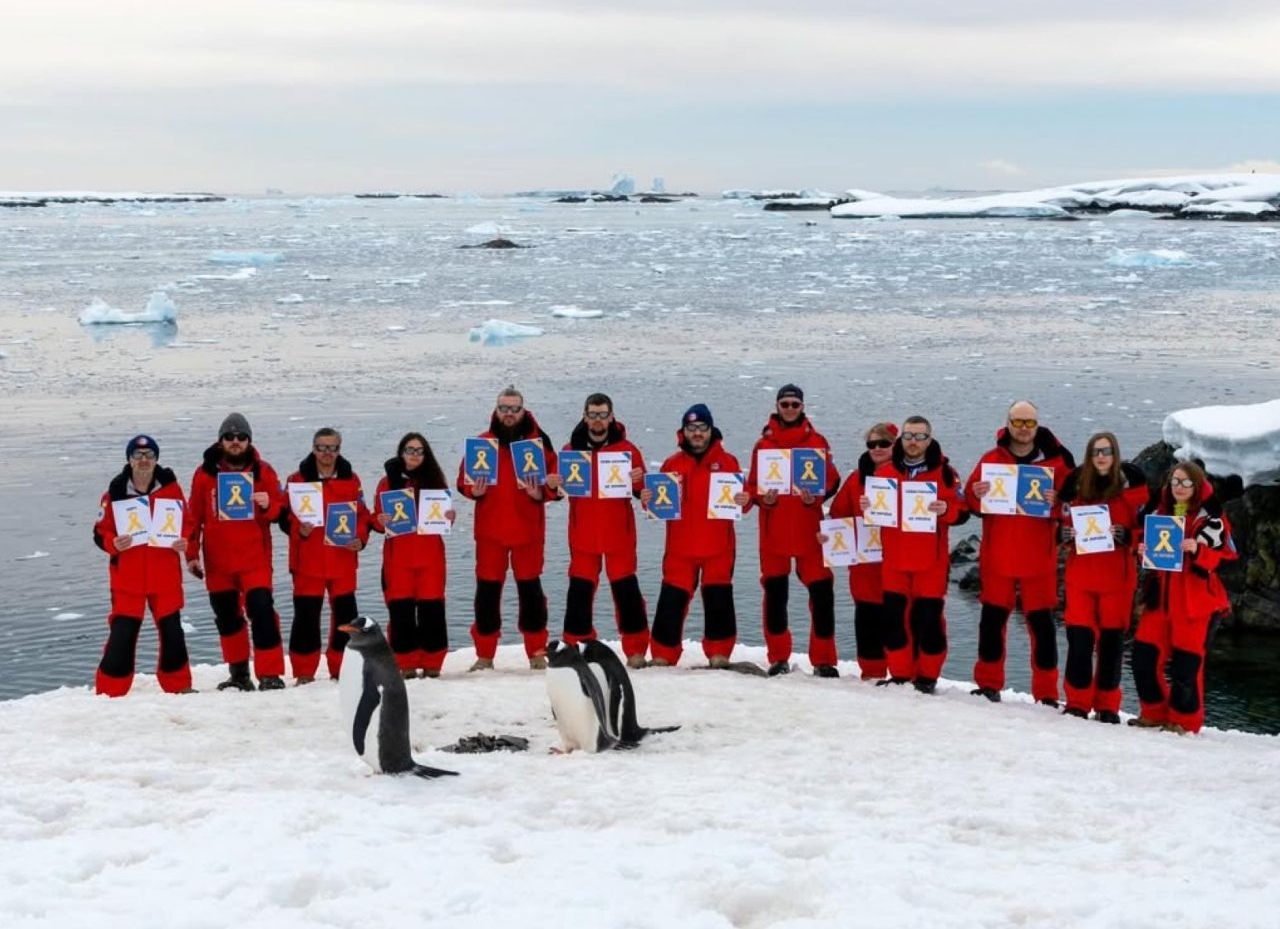
Main image: On the Day of Dignity and Freedom, members of the 30th Ukrainian Antarctic Expedition remind the world – Crimea, Donetsk, Luhansk, Zaporizhzhia, and Kherson regions are Ukraine Source: National Antarctic Scientific Center of Ukraine