
A combat zone is not only ruins, but also fields riddled with explosion craters. What could be done after the war?
Agricultural lands in Ukraine during the war
In 2022, UWEC—an organization uniting environmental scientists and activists from Russia, Ukraine, Belarus, Germany, and the United States—analyzed a satellite image of an arable field near the city of Izium in Ukraine’s Kharkiv region. They counted 2,052 craters from munitions of various calibers. According to different estimates, military operations in Ukraine have affected between 25% and 33% of all arable land.

— All these lands can be условно divided into two parts. The first consists of areas that are mined; they need demining and can then return to what they were before. The second includes fields where intense fighting took place. These areas are covered with craters, they are vast, and they are contaminated with sulfur and heavy metals from exploding shells, — says Oleksii Vasyliuk. — From an environmental standpoint, these territories cannot be used for agriculture. I would not want to eat food grown on such land. Large amounts of sulfur, when in contact with water, form sulfuric acid. As a result, both fauna and plants suffer. Heavy metals also accumulate, including in plants. And then we eat that? No—it may not be lethal, but it is still harmful: it reduces life expectancy and worsens health.
According to Eugene Symonov, the prospects for reclaiming arable land depend on the intensity of the physicochemical impact on fields during hostilities, as well as on overgrowth by woody vegetation and changes in water regimes.
— Agricultural specialists from Sumy, who conducted direct measurements of the consequences, are somewhat more optimistic than our group: they found that pollutant concentrations in fields are mostly within permissible limits, — Symonov says. — Soil scientists, however, are not so optimistic.

According to a study by soil scientists who examined fields in the Olkhovska community of Kharkiv region and the Sartana community in Donetsk region, restoring the land will require rather costly biological remediation methods—for example, growing sunflowers or spring rapeseed for several years, as these crops can extract heavy metals from the soil. However, they cannot then be used for food.
Oleksii Vasyliuk notes that many countries abandon agricultural use of land that has been heavily contaminated by wars—France, for example, still does not use certain areas damaged during the First World War, more than 100 years ago.
How do fiber optic drones harm the environment?
In recent years, new pollutants have also emerged. Among them, fiber-optic drones stand out in particular. In May 2025, Russian media outlets and social media channels circulated a video showing soldiers walking across a field strewn with white threads. “Now we’ll be catching crucian carp with fiber optics. Look, the fisherman is dragging one along,” one of them jokes while filming how the cable has caught on a fellow soldier’s leg.
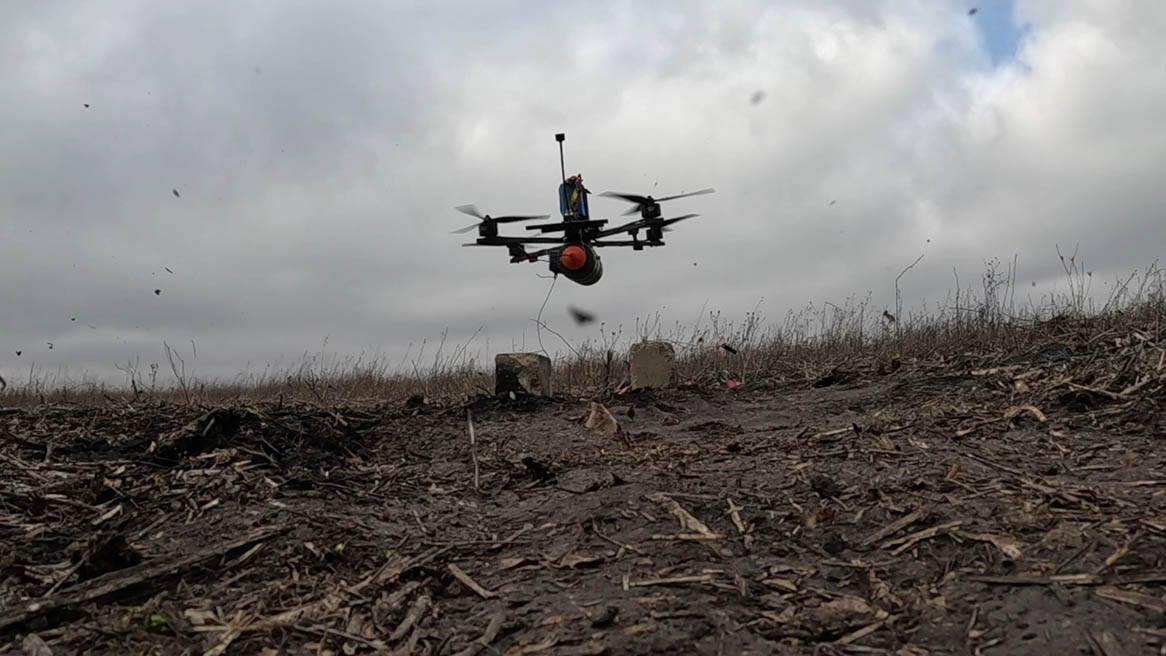
When fiber-optic drones first appeared, they were described as a breakthrough, while setting aside both the moral dimension—their very purpose is to take lives—and the environmental trace left by their use.
Fiber optics are a powerful pollutant. They are made from either quartz glass or plastic. According to Leon Morland, a researcher at the British organization The Conflict and Environment Observatory, plastic material is more suitable for military purposes because it is more flexible and lighter than glass. At the same time, the decomposition period of plastic fiber-optic cables exceeds 600 years.
For nature, military fiber optics already pose a danger today: birds and animals can become entangled in discarded cables. Once caught and trying to free themselves, they only wind the cable tighter around their bodies and ultimately die from suffocation or starvation.
— Over time, fiber optics degrade under sunlight. If they are not collected, they will gradually turn into crumbs scattered everywhere, — says Oleksii Vasyliuk. — Perhaps this is not absolutely catastrophic, but it would be better to collect them. And it must be said that, unlike sulfur and heavy metals, fiber optics can at least be mechanically gathered. It is the only pollutant that remains on the surface—the only one that can simply be collected.
War against Ukrainian fauna
Warfare poses a colossal threat to animals. It destroys their habitats and kills them directly.
— Along the Siverskyi Donets River, almost all forests burned down—from Izium to the Russian border. There used to be pine forests there that hosted the largest concentration of birds of prey in Ukraine. Now that place no longer exists: the river floodplain remains, but the forest is gone. Since birds are migratory, at some point they returned and found no place to come back to, so they flew elsewhere—perhaps to Russia, perhaps to western Ukraine, perhaps to Sweden. It is important to understand, though, that birds at least survived, — Oleksii Vasyliuk emphasizes. — For mammals, especially at the beginning of the war, the situation was worse. Predators and ungulates moved very actively, and traffic accidents involving them increased noticeably. They encountered many obstacles—fences, settlements. They were not always able to leave the combat zone.
“Birds, fox cubs, and deer fawns with various injuries end up in rehabilitation centers. These are the ones that could be found, seen, and brought to veterinary clinics, but thousands of animals have no chance of help. They are threatened by missile strikes, artillery shelling, explosions from mines and tripwires, numerous fires, internal organ damage from blast waves, and stress caused by the noise of warfare,” UWEC wrote in 2022.
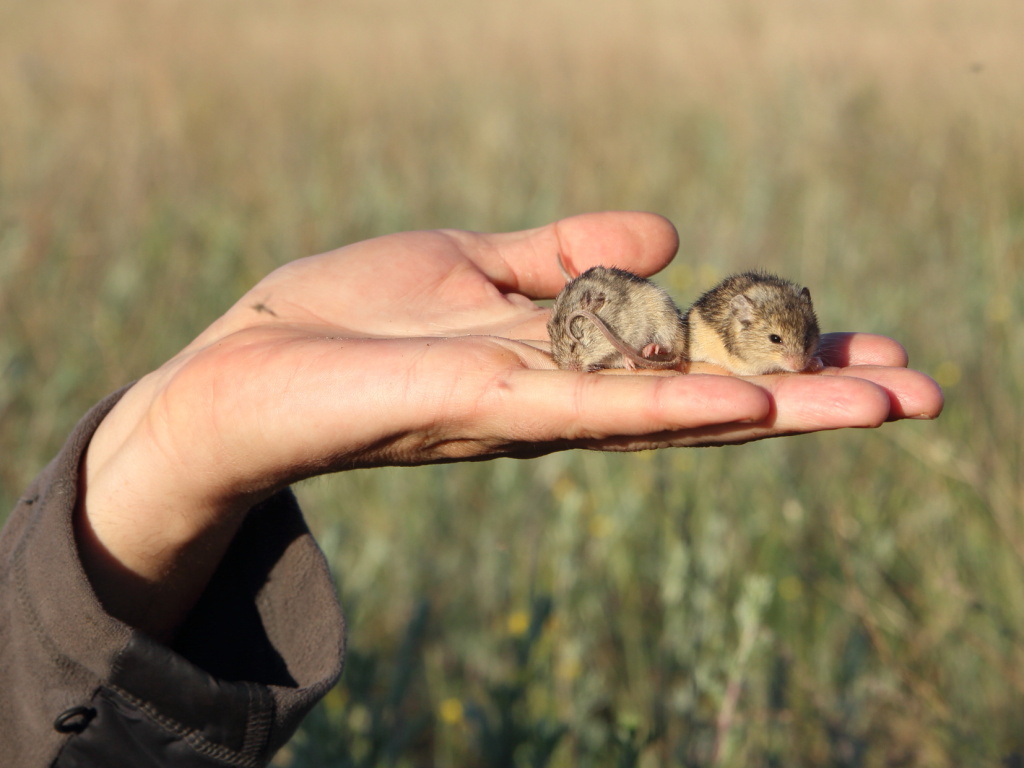
However, as combat tactics changed—especially with the onset of the mass use of drones—the situation for animals also changed. No one knows for sure what is happening to them on the front line. But theoretically, conditions for those that survived should have become easier.
— Since vast areas are no longer being saturated with fire from Grad rocket systems and the number of explosions has decreased, many species have gained a chance outside fire zones—for example, in wetlands, — says Oleksii Vasyliuk. — We see this, for instance, with steppe marmots. They used to have several hundred colonies—mainly in Luhansk region and partly around Kupiansk. They were monitored because their burrows are clearly visible on satellite images. Now there are more than four thousand colonies—about ten times more than before. This clearly shows that marmot populations are regulated solely by hunting. No one is shooting them now—what kind of hunting can there be in a combat zone? As a result, their numbers have begun to approach an optimal level. Another example: poisoning of mice in fields has stopped. There are more mice—food resources for predators have appeared. As a result, the marbled polecat, a Red Book species that previously had only rare sightings, now constantly appears in soldiers’ videos. Quite literally, there are now more videos featuring marbled polecats than documented scientific records of the species over the past 20 years. In summary, some animal species have benefited from the cessation of hunting and other human economic activity, but of course, for the majority, the effects of the fighting itself have been far worse.
From an article in Novaya Gazeta
Recent posts:
- Building Back Business as usual: Can the Rapid Damage and Needs Assessment provide strategic planning support for green rebuilding of Ukraine?
- LNG dependency poses a risk to Europe’s climate ambitions
- Four years of full-scale war in Ukraine: the environmental perspective
- Russia’s attacks on vegetable oil facilities open a new front in its war on Ukraine
- Fiber-optic web: How the use of drones on the frontlines impacts the environment