Martin Vrba, Marta Abbá
The end of Russian gas imports to Europe in response to the full-scale invasion of Ukraine and their replacement with LNG was supposed to be a temporary emergency measure. However, the pace of LNG infrastructure development in Europe suggests that it will not be able to easily phase out fossil gas in the foreseeable future.
From the start of Russia’s full-scale invasion of Ukraine in February 2022 until the end of last year, Europe built ten floating liquefied natural gas (LNG) regasification units and expanded seven existing terminals, increasing the total capacity of existing infrastructure by around 50 billion cubic meters per year.
However, the unprecedented pace, against the backdrop of an emergency, will have consequences for decades to come. The paradox is clear: while import capacity is growing, gas consumption in the EU fell by 20% between 2021 and 2024 (IEEFA EU Gas Flows Tracker). The result is not a more secure system but dependence on fossil fuels, which will shape European energy policy until at least the middle of the century.
On the one hand, this is an undeniable success in building infrastructure, which, under normal circumstances, would encounter a web of bureaucratic obstacles. In the long term, however, there is little cause for celebration. The European energy crisis, caused by dependence on Russian gas imports, has been temporarily averted, but only by replacing one dependency with another.
Russia, which has proven—to put it euphemistically—an unreliable trading partner, is largely out of the picture, but there are questions about the reliability of new fossil fuel exporters.
Question of origin: Mozambique, the United States and political instability
LNG imported into European terminals is not merely a technical matter. It involves a global chain of extraction, exploitation and environmental pollution.
The United States is currently the main exporter of LNG to Europe. A report by the Italian organization ReCommon, “The Dark Side of US LNG” (April 2023), documents how gas liquefaction plants along the Gulf Coast—primarily in Texas and Louisiana—have turned entire communities into “sacrifice zones.” Air pollution, water contamination, respiratory diseases and cancer: the threats to health and the environment remain local, while European countries and multinational corporations benefit.
In Mozambique, Eni’s Coral South FLNG project, which has been in operation since 2022, is the target of serious allegations. The 2024 report “Hidden Flames” reveals how greenhouse gas emissions were deliberately underestimated by up to 50% in contradiction to current satellite data. A follow-up report from February 2025 reveals Eni’s attempt to finance the expansion of the Coral North project, leading to the forced displacement of locals, violence and further environmental devastation.
Captive to fossil gas
As ReCommon points out: “Following Russia’s invasion of Ukraine in 2022, liquefied natural gas became one of the pillars of Europe’s energy policy. Within a few months, LNG was presented as the fastest way to replace Russian gas, ensure supply continuity and reassure markets and governments. This acceleration led to infrastructure, contractual and geopolitical decisions that now threaten to turn what was originally an emergency measure into a structural obstacle to Europe’s energy transition.”
This is a systemic problem. Infrastructure designed to last decades, twenty-year supply contracts and investments worth billions of euros: all point to the continued use of gas, even as demand falls and climate targets require its rapid reduction. Methane emissions in the LNG supply chain are up to 80% higher than for pipeline-supplied gas over a 20-year horizon, which can represent 5-8% of national carbon budgets.
According to energy expert Francesco Sassi: “The dramatic development of this infrastructure actually threatens to block the development of alternative policies from both an economic and infrastructural point of view.” He adds: “The signal is coming from Brussels and it is very clear, but at the same time it contradicts the diversification of energy sources. In the short term, imports of Russian gas, including LNG, must be eliminated, and in the medium and long term, much more must be invested in renewable sources. For Brussels, this strategy has always represented two things that are in harmony. However, this only works on paper for European politicians, who have demonstrated little knowledge of energy markets, the energy industry or energy geopolitics.”
At the same time, this is not a new finding: shortly after Russia’s invasion of Ukraine in 2022, Energy Monitor warned that Europe’s efforts to diversify its fossil fuel sources could lead to decades of dependence on fossil fuels. As Esther Bollendorf of Climate Action Network Europe pointed out: “Building new LNG infrastructure takes at least two to three years, and with a payback period of 30 to 40 years, this means we will be stuck in the current situation for a long time to come.”
While the EU officially commits to the Green Deal and climate neutrality targets by 2050, it is building an energy system that makes achieving them increasingly difficult. Regasification capacity continues to grow, while consumption is falling. The result is excess capacity, which pressures the use of gas even when it is unnecessary and slows investment in renewables and energy efficiency.
The (un)reliability of American LNG
As ReCommon further emphasizes: “The role of the United States is key here. Washington is currently the main supplier of LNG to the European Union. The IEEFA analysis warns that if current policies remain unchanged, by 2030 up to 75–80% of LNG imported into the EU could come from the US, covering about 40% of total gas imports. This means replacing one dependency with another.”
In addition, under the Trump administration, the United States openly opposes European regulations on methane emissions in the LNG supply chain. These regulations require suppliers to monitor, track and report methane leaks, but it appears that US LNG producers are refusing to invest in the necessary control systems. The result is uncontrolled methane leaks, which highlight the structural incompatibility of the LNG supply chain with European climate commitments.
The narrative of American LNG as a “reliable” supplier is crumbling in the face of reality. Trade jitters over Trump’s foreign and economic policies, the use of energy as a geopolitical tool and threats of tariffs reveal the fragility of the idea of a neutral energy ally. Europe has replaced its dependence on Moscow with dependence on Washington, exposing itself to the volatility of global LNG markets, where prices fluctuate with dynamics in Asia and the Middle East.
Francesco Sassi warns that “European consumers will become increasingly vulnerable to international instability because of their dependence on liquefied natural gas, which is subject to global market competition.” Looking ahead, he says, “The way Europe continues to address this issue leads me to conclude that we are very close to another energy crisis, caused mainly by a political inability to understand the world we live in.”
Absence of public debate
One of the most worrying aspects, however, is the lack of public debate. Sassi criticizes, “No one wants to address this issue because the economic interests behind it are simply too powerful.”
On top of all this, there is the constant threat of fluctuating energy prices and a new dependence on American LNG. “Today, we are seeing international tensions between former allies, which are also reflected in the energy markets and the resources we use every day, so we cannot avoid this debate.”
ReCommon adds, “We must recognise that LNG is not just fossil gas imported by ship from afar. It is a global chain that includes extraction, processing, liquefaction, shipping, regasification, and the construction of new infrastructure. Focusing only on the last part of the chain—regasification in ports and transport across Europe—means failing to see the overall impact of this energy source.”
Where is Europe headed?
Four years after the crisis, Europe faces a strategic decision that can no longer be postponed. The hastily built LNG infrastructure is becoming permanent. Twenty-year contracts with suppliers from the US, Qatar, and Mozambique are reshaping the continent’s energy geography. The real risk is that the urgency of energy security—legitimate in 2022—will become an excuse to postpone the green energy transition.
Sassi points out, “The risk is that the current focus on energy security is weakening the goal of energy transformation and pushing it into the background.” He adds “Politics directs money to what it considers a priority in terms of the needs of the population, and if the acute challenge is to ensure that our infrastructure has enough gas to heat homes, then this is such an urgent matter that investment and attention naturally go there.”
The real costs of these decisions will not be borne by corporations but by citizens: “The costs of expanding LNG imports will not be covered by the private sector but will increasingly burden public budgets, as none of the energy players is willing to make the long-term investments we are seeing today, given the existing risks.”
ReCommon concludes unequivocally: Continuing to invest in LNG as a pillar of Europe’s energy strategy slows the energy transition and ties Europe’s energy future to an increasingly unstable and politicized global market. The real alternative is not to choose another fossil gas supplier, but to structurally reduce dependence on gas as such.”
This text and its Italian counterpart were produced as part of PULSE, a European initiative promoting cross-border journalistic collaboration, in partnership with OBCT, n-ost, and Voxeurop.
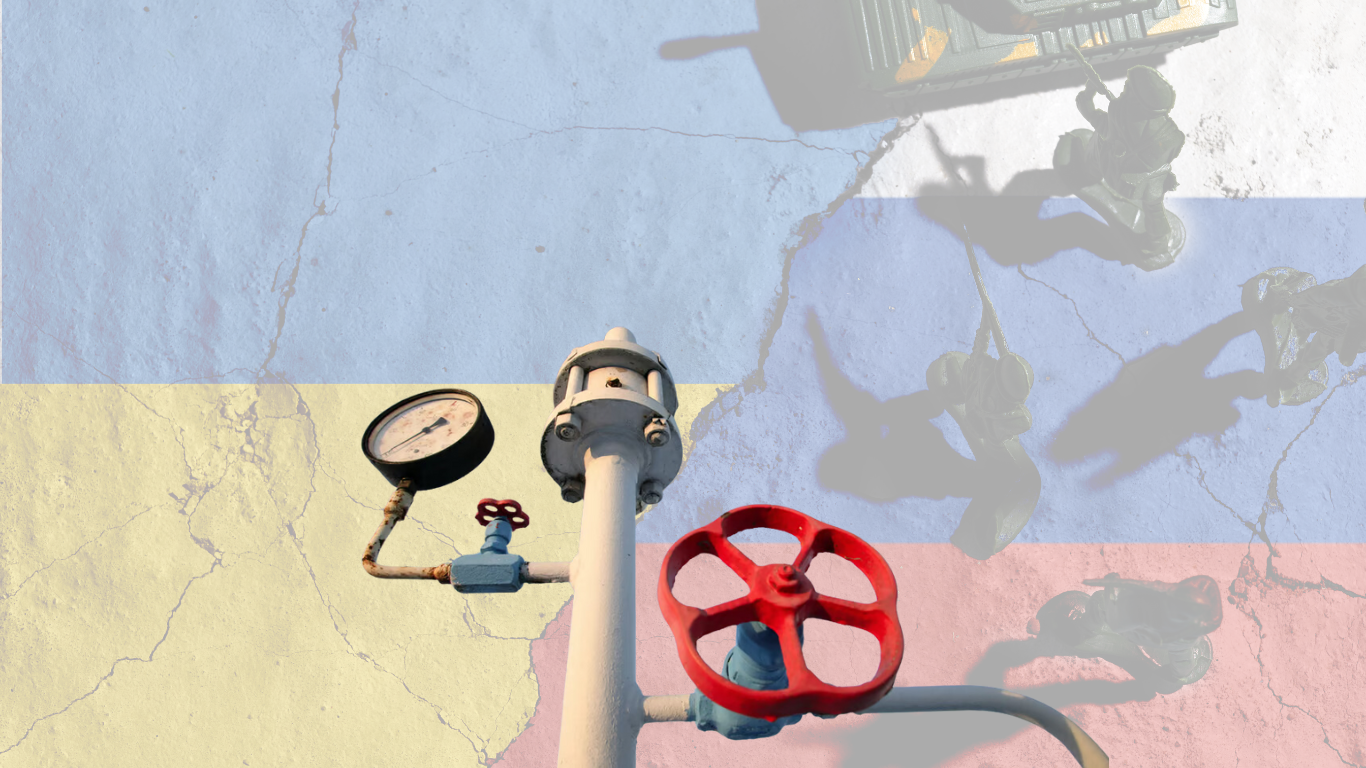
Main image source: gfsis.org