
Whether the decision is made to restore destroyed cities or to build new ones, two questions will inevitably arise: what to do with the ruined cities, and how dangerous are they for the environment?
Asbestos in Construction Debris
In 2017, Doctor of Technical Sciences Hennadiy Drozd, a professor at Luhansk State University, studied the possibilities for recycling and disposing of construction waste resulting from destruction in Donbas. He noted that in peacetime, construction waste is simply buried, but even then—eight years ago—so much debris had accumulated in Donetsk and Luhansk regions that there was nowhere left to bury it. Today, its volume has increased hundreds, if not thousands, of times.
In his research, Drozd calculated that about 15% of destroyed material is waste that cannot be reused and can only be taken to landfills. This includes, for example, piles of plaster and gypsum. However, broken glass, wood, roofing materials, and most importantly reinforced concrete, bricks, and other core building materials can be recycled and reused in construction.
— From an environmental perspective, the remaining concrete or brick walls are certainly not beneficial, but they also do not pose a serious threat. The exception is slate roofing, which is made from asbestos. European environmental experts constantly ask whether there is an understanding of how to collect slate debris, — says UWEC expert Oleksii Vasyliuk.
Asbestos is a toxic substance capable of causing malignant tumors in both humans and animals. Its popularity in the Soviet Union was due to insufficient research, and in the post-Soviet space to economic inertia and entrenched ways of thinking. Today, however, asbestos is banned in 50 member states of the World Health Organization.
— And here, this slate is everywhere, even in the smallest villages. We do not know how much of it there is, but it is obvious that we are unjustifiably underestimating its danger, — Vasyliuk continues. — But what we do assess correctly, and what is far worse, is the destruction of industrial infrastructure. In Donbas, coal enterprises have been almost completely destroyed. This threatens the flooding of mines and the release of polluted mine water to the surface. All mines are connected by drainage systems, meaning that flooding one leads to the flooding of others in a chain reaction. And all of this will, one way or another, flow into the Sea of Azov: partly directly, partly through the Siverskyi Donets and the Don rivers.
Flooded Mines
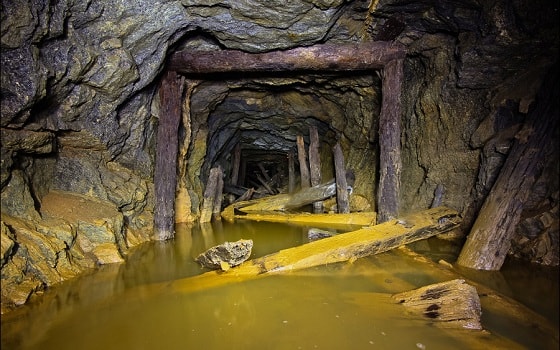
Mine water in Donbas may be contaminated with a large number of substances dangerous to humans and nature: mercury, lead, chlorides. But the main threat is that it may be radioactive.
This danger emerged long before 2022.
In 2018, the authorities of the so-called “DPR” decided to flood the closed Yunkom coal mine in the town of Yunokomunarivsk near Yenakiieve. The mine had ceased operations back in 2001 as unpromising. However, neither authorities nor miners considered flooding it possible at that time—24 years ago. The reason was that in 1979, a nuclear explosion had been carried out at Yunkom. Soviet authorities believed this would solve the problem of methane accumulation in coal deposits. However, this goal was not achieved.
Geologist Yevhen Rudnev notes that after the explosion, residents of Yunokomunarivsk and Yenakiieve began to suffer en masse from “the same illnesses as the liquidators of the Chornobyl nuclear power plant accident.” Samples taken from the mine showed enormous radioactive contamination—60 curies (the norm is less than 1 curie).
That is why the decision was made to conserve the mine not through traditional flooding, but by an expensive “dry” method, which, among other things, requires constant spending on pumping out water. Until 2014—that is, until the start of hostilities in eastern Ukraine—Kyiv officially allocated $5 million annually for this purpose. The “DPR” later stated that it did not have such funds.
Rudnev describes the potential consequences of flooding Yunkom as follows:
“If the pumping installations are flooded due to prolonged power outages, groundwater levels will rise. The ‘sealed’ capsule containing radioactive materials will rupture, and the contaminated matter will rush with the water through the mine galleries. This water will rise and, through a number of old, unsealed boreholes, reach the surface. The contamination of the area will be monstrous—approximately 1,000 microroentgens per hour.”
For comparison, a radioactive background of up to 50 microroentgens per hour is considered safe for humans.
What is currently happening with the contaminated water at Yunkom is not reliably known. In September 2025, some Ukrainian media reported that samples taken within a 5 km radius of the mine showed radioactive contamination of drinking water aquifers. At the same time, the documents with recorded measurements were not published. The Russian side did not report any studies at all.
— And there is an important point here: Donbas is a steppe region. Local residents have historically had problems with water. Many people draw water from underground sources. How do you explain to them that a well is no longer a source of life, but a source of danger? — asks Oleksii Vasyliuk. — Speaking plainly, water can now only be delivered to settlements.
Ruined Cities and Chemical Plants
The destruction of the chemical industry adds to the concern.
— Take Sievierodonetsk and Rubizhne as examples, — the environmental expert continues. — As far as I know, 36 chemical industry enterprises in these cities have been damaged to one degree or another. Each of them must have raw material warehouses, product storage facilities, treatment plants, and waste storage sites that are not recycled. All of this has been damaged by explosions. Because there is no access, we do not understand how much hazardous material has entered the environment. The same applies to industrial giants such as Azovstal. This enterprise, located directly on the shore of the Sea of Azov, has been completely destroyed. Waste has entered the sea. From an environmental standpoint, this pollution is far more dangerous than the destruction of residential buildings in the rest of Mariupol. Toxic substances have entered the water; they have already been and will continue to be absorbed by fish—and people will eat that fish.
From an article in Novaya Gazeta
Recent posts: