Eugene Simonov
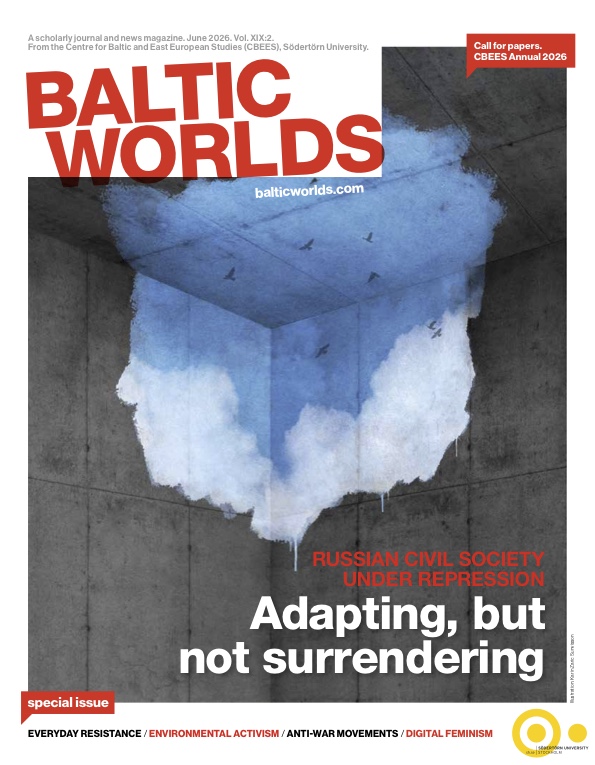
UWEC Work Group has long aspired to explore the transformation of Russian environmental civil movements under war-time pressures. The June 2026 special issue of Baltic Worlds (Vol. XIX:2), titled “Russian civil society under repression: Adapting, but not surrendering” is just such an opportunity. UWEC reviews several analyses of the Russian environmental movement.
Baltic Worlds details a chameleon strategy of adaptation, where Russian activists shift from visible political protest to subtle, professional and localized resistance. By examining environmental movements, digital feminism and educators’ strategies, the issue demonstrates that while institutionalized structures face dismantlement, grassroots agency persists thanks to strategic depoliticization and cross-border solidarity networks.
Russia’s policies and practices clearly demonstrate that environmental and climate issues are not a state priority. Is civil society capable of standing up for the environment amid war and repression? This collection demonstrates how civic initiatives in Russia continue to operate in today’s circumstances. The UWEC editorial board finds that these studies reflect only a part of the spectrum of environmental problems and challenges facing Russian civil society today. For example, there is virtually no information on the struggles of Indigenous peoples to protect their traditional lands and other environmental rights, and the mechanisms and scale of repression against environmental activists and the arrests of environmental scientists have not been fully analyzed. Baltic Worlds focuses on one path of the environmental movement’s evolution, namely the mechanism of situational adaptation, including through a shift toward small-scale “non-political” actions aimed at “protecting one’s own backyard.” In the late Soviet Union, this path of isolated, grassroots civil society development worked to some extent, laying the ideological and human resources groundwork for the explosive growth of large-scale environmental initiatives that occurred during perestroika. Only time will tell how effective this mechanism remains in this new cycle of totalitarianism.
The final essay in the collection “And this is not a spy novel”, written by experts under the pseudonyms of Elisa Marin and Oliver Skye, is devoted to the risks, limitations and paradigm shift in research on activism in Russia after February 2022. The article helps explain why this research collection does not cover the full spectrum of issues in environmental activism and why significant gaps remain on a number of the most sensitive topics. The authors demonstrate how, under the pressure of risks, opportunities for “participatory” research within activist circles are narrowing, and only the partial publication of the resulting materials was possible due to security concerns for both activists and scholars. The already fine line between activists and sociologists is nearly non-existent, and the research ultimately loses its air of “academic objectivity.” Meanwhile, “remote analysis” of the development of civic initiatives based on publicly available materials cannot provide a reliable picture of what is happening. Given the widespread prevalence of authoritarian tendencies around the world, the authors call for a reevaluation of the objectives, methods and codes of conduct for conducting research in authoritarian environments.
From protest to survival: a chameleon strategy
The overarching focus of this special issue, guest-edited by (independent expert operating under a pseudonym and conducting research inside Russia), is a direct challenge to the narrative that Russian civil society has “died” following Russia’s full-scale invasion of Ukraine in 2022. As Kalinina notes in her introduction, “To be or not to be? Russian civil society under repression,” the focus has shifted from whether activists can “stop the war” to how they survive and evolve under “prolonged repression”.
The journal identifies a chameleon strategy among activists. To avoid labeling as foreign agents and criminal prosecution, activism has moved from the streets to more “subtle, non-heroic forms”. The scope is remarkably broad, covering the everyday resistance of teachers and physicians navigating the dilemmas of “professionalism versus politics”, digital feminism, anti-war movements in Russia’s titular Indigenous republics and how the constraints imposed on internet use force activists to use flawed digital platforms because there is no alternative.
A central conceptual pillar of the issue is the segmentation model proposed by Irina Meyer Olimpieva (research professor at George Washington University). She argues that while “politicized and formalized organizations have experienced sharp repression,” grassroots initiatives have “expanded, often adopting informal, decentralized and digital forms”. This sets the stage for the issue’s deepest dive: the environmental movement.
Reconfiguration of environmentalism: GONGOs and green patriotism
A major portion of the issue focuses on how the Russian state has reorganized environmental discourse to serve its own geopolitical ends. In their peer-reviewed article, Doriana Althier (a pseudonym for an independent researcher), Maria Tysiachniouk, and Juha Kotilainen (both researchers at the University of Eastern Finland) examine the rise of “Sovereign Ecology.”
The authors argue that the state uses GONGOs (government-organized non-governmental organizations) to co-opt ecological discourse. These organizations, such as the Russian Ecological Society, reframe nature as a “national asset” to be protected from “foreign normative intrusion”. They cite United Russia political party functionary Boris Gryzlov, who describes the platform as a way to ensure a “new level of environmental sovereignty of the Russian Federation”. This reorganization was facilitated by a massive legal crackdown: between 2022 and 2023, the state designated major international watchdogs like Greenpeace International, WWF International, and the Norwegian Bellona Foundation as “undesirable organizations,” criminalizing their activities and forcing them to leave the country.
Read:
Greenpeace: Instead of an epilogue
Under the guise of defending nature… they tried to influence government decision-making
This “green patriotism” serves two functions. On the one hand, it allows the state to perform “care” for the environment while ignoring systemic extractivism in its basic form. On the other hand, it creates a “patriotic” standard that labels independent activists as “marginal” or “pro-Western”. Althier and her co-authors note that this has led to the movement’s “polarization”. While independent non-governmental organizations (NGOs) are “marginalized and often only able to operate as informal networks,” state-aligned groups receive “institutional support and symbolic recognition”.
Adaptation and a NIMBY shift toward local survival
In her article, Svetlana Erpyleva (post-doctoral researcher at the University of Bremen) provides a holistic case study of the Russian climate movement (specifically, groups inspired by Greta Thunberg’s Fridays for Future). She identifies a clear trajectory for the movement’s demobilization. Erpyleva argues that the war acted as a “last straw” for a movement already weakened by the 2020 pandemic and repressions in 2021. Crucially, she observes that the war redirected the attention of activists. As one interviewee, Sveta, states: “It was unclear how we could even talk about climate issues when something like this was happening”. Many activists concluded that “the issue of climate change has faded into the background” in favor of more urgent wartime survival challenges.
However, both Erpyleva and Vitaly Servetnik (grassroots activist and founder of the Environmental Crisis Group) highlight a vital adaptation in their articles: the shift toward place-based environmentalism. Since public protest is now too risky, activists have refocused on “practical activities” like plastic recycling and garbage collection, “flower protests” (folk memorials that serve as covert anti-war expressions), and NIMBYism (Not In My Backyard) – protesting specific landfill sites or the destruction of local parks.
Strategic resistance efforts continue against the weakening of environmental protections in protected areas. Servetnik and Althier et al. document the activities of the Reserve Alliance (Zapovednyi Al’ians), formed in 2023. This coalition of 48 NGOs monitors nature conservation legislation and, in particular, has petitioned the Prosecutor General regarding illegal clear-cutting in a planned nature reserve in Karelia in 2023 as well as attempts to weaken protection measures in nature reserves in Moscow in 2025. Other (mainly pre-war) resistance “hotspots” include the defense of the sacred Kushtau Mountain in Bashkortostan and long-standing protests against the Shies landfill in Arkhangelsk region.
Servetnik notes in his essay that environmental issues remain relevant for citizens because they are “easy to see, smell and feel”. He reports that despite the crackdown, there were 580 documented environmental protests in 2024, making ecology the second most popular reason for protest in Russia. This suggests that “strategic depoliticization”—framing work as non-political to stay afloat—has become the primary survival tactic.
Read more:
Potential for change: environmental justice as political resistance
Baltic Worlds concludes its environmental inquiry by discussing civil society’s potential to spark broader political change. Servetnik argues that the Russian environmental movement has a “relatively privileged position” compared to human rights groups because conservation has not been “completely criminalized”.
He posits that because environmental issues are intrinsically linked to “socio-economic injustices”—such as Moscow-based companies extracting resources from Russia’s regions without local consent—they serve as “groundwork for potential mobilization”. This is especially evident in Russia’s Indigenous national republics, for example in the Komi Republic, where residents view the flow of resource income to the federal center as a form of colonial exploitation. Servetnik concludes: “In undemocratic and unequal social and economic systems, environmental issues are often seen as environmental injustices.”
The effectiveness of grassroots environmentalism is also confirmed by the results of Environmental Crisis Group’s 2025 monitoring report published in June 2026. In 2025, ECG recorded 175 environmental victories achieved through environmental activism in Russia. The greatest number of victories were achieved by environmentalists and activists defending many parks and other protected areas: 89 victories, of which 77 were court cases won regarding the unlawful reclassification of forests within protected areas as exploitable. In second place was the protection of forests, parks and public gardens (30), and in third place was the protection of water bodies and fights against waste disposal sites (14 victories each). In some cases, activists managed to put a definitive end to the struggle over a specific natural area. In other situations, activists were able to halt development, secure the initiation of criminal proceedings against companies violating environmental legislation or win their case at the first instance. This is the most impressive list of achievements since the start of the war; it demonstrates the environmental movement’s growing ability to adapt to new conditions.
The June 2026 issue of Baltic Worlds paints a picture of a civil society in a state of “active waiting”. Whether it is the practice of “doublethink” or environmentalists focusing on local issues to avoid “rocking the boat”, the journal clearly shows that Russian citizens’ ability to take active steps to protect the environment—efforts still permissible in this repressive civil society space—has not disappeared.
Nadezda Petrusenko (senior lecturer at Södertörn University) notes in the afterword that the environmental movement’s ability to maneuver within administrative spaces suggests that “the politicization of a currently apolitical environmental movement is a real possibility”.
Ultimately, Baltic Worlds argues that, while the state has “intensified its efforts to mobilize citizens in support of the regime,” civil society survives through “low-visibility and outwardly depoliticized informal forms of dissent”. Environmental activism, in its shift from global climate protests to the local defense of “ancestral land,” stands as the most resilient example of this adaptation.
Main image: Cover of the special issue of the Baltic Worlds Source: balticworlds.com