Olha Tkach
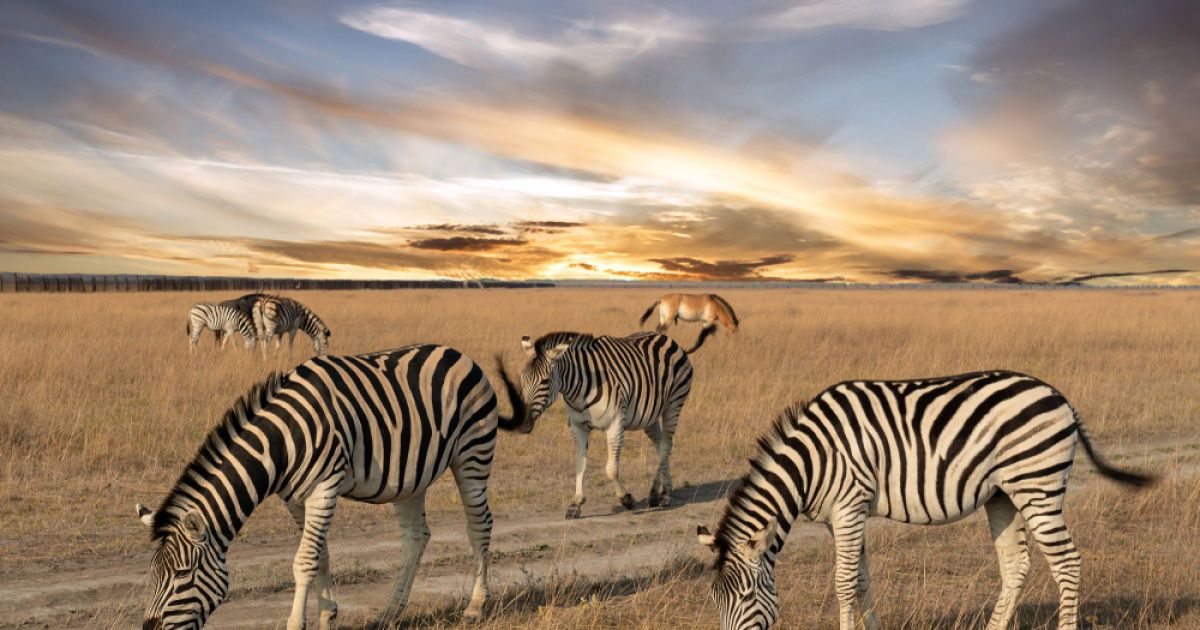
A new investigation shows that Russian-installed authorities in southeastern Ukraine have been illegally removing animals from one of the country’s oldest and most important steppeland reserves, including rare species such as Chapman’s zebra.
An investigation by a Ukrainian environmental media outlet has revealed that Russia is using Ukraine’s Askania-Nova Biosphere Reserve, Europe’s largest steppeland conservation area, as a hub for illegal transfers and sales of animals, including rare and protected species.
One of the most important centers of the European steppe ecosystem, Askania-Nova is located in the south of the Kherson region, an area which was swiftly overrun by invading Russian troops in early 2022 and has been under occupation ever since.
URSA.MEDIA’s investigation team corresponded (via Telegram and email) with the reserve’s Russian-installed management and discussed the sale of animals with potential buyers, including rare Chapman’s zebras. In one particular exchange, the occupation administration asked for about one million Russian rubles (around $12,000) per animal.
“Askania-Nova has lost ten Chapman’s zebras—nearly one-third of the entire herd once kept at the reserve,” Viktor Shapoval, the reserve’s director, told URSA.MEDIA. “What actually interests those who are removing the animals? They’re rare and exotic species. So it’s not surprising that zebras are in demand.”

As he explained, the removal of animals from the reserve took several forms, ranging from public events to covert operations. The first documented cases of illegal animal transfers date to late 2023; at least 20 such incidents have been recorded to date.
“Sometimes the removals were carried out with great publicity, as in the case involving Oleg Zubkov, the director of the Yalta Zoo,” said Shapoval. “But that wasn’t always the case. Very often, transfers were arranged quietly, especially when animals were being moved into the territory of the Russian Federation.”
One such incident involved the transfer of Przewalski’s horses to Russia’s Rostov region. This species is listed in the Red Book of Ukraine and also included in the appendices of the Convention on International Trade in Endangered Species of Wild Fauna and Flora (CITES).
The convention—also ratified by Russia—establishes strict regulations on the movement of such species and requires official authorization from competent authorities. These requirements have been completely disregarded by the occupation administration.
Journalists have also discovered listings on the Russian classifieds website Avito advertising animals from Askania-Nova for sale. According to the investigation, private zoo and park owners in Crimea and Krasnodar Territory were involved in these illegal transfers.
Over 125 years of conservation history
Spanning more than 33,000 hectares of virgin steppe, the Askania-Nova Biosphere Reserve dates back to 1898, making it Ukraine’s first nature reserve. It was established on the privately held lands of Friedrich Falz-Fein, a descendant of German colonists.
Askania-Nova is home to more than 2,500 plant species and around 2,200 animal species, over 300 of which are protected species listed in Ukraine’s Red Data Book. The reserve lies on a major migratory corridor, with up to 800,000 birds crossing its territory annually.
Officially designated a biosphere reserve in 1919, today Askania-Nova is a significant research center and a member of UNESCO’s Man and the Biosphere program. It plays a vital role in the preservation and restoration of rare wild species.
“Askania’s animal population is unique. Its history spans not decades but centuries. A distinct genotype has evolved within this reserve—animals adapted to the steppe environment of Ukraine, and therefore clearly different from their counterparts in natural ranges,” said Viktor Shapoval.
After Russian-installed authorities took control of Askania-Nova in spring 2023, its Ukrainian management effectively lost access to the reserve, meaning they are now reliant primarily upon Russian media and social platforms for information about conditions inside Askania‑Nova.
Headlines such as “Animals from Askania Transferred as Part of Exchanges to Krasnodar Territory, Crimea, Rostov‑on‑Don, Ryazan” or “Askania Steppes on Fire” provide only fragmented glimpses of the devastation unfolding within the reserve.
Covering their tracks
According to Shapoval, much of the information about these incidents was deliberately suppressed. Public statements from the occupation administration often mentioned only the “arrival” of new animals, while the details of their illegal removal were omitted.
“It doesn’t matter what exactly is being removed—even if it’s ordinary livestock. The issue is that all of this is being done in violation of both national legislation and international law,” he said.
“There were cases where such criminal actions were carried out entirely behind the scenes, and no mention of them appeared at all on occupation-controlled platforms.”
Shapoval added that, as a result of neglect under occupation, the reserve’s collection of African Cape buffalo (Syncerus caffer caffer) has been virtually wiped out.
“It’s obvious that a buffalo native to Africa cannot tolerate open steppe conditions in December—these are warm-climate animals, not adapted to low temperatures,” he lamented, adding that four buffalo had died as a result of negligence by the occupation authorities. “Three died of hypothermia,” he explained, “and another broke its neck after striking a tractor during forced herding.”
Too much fire, not enough water
According to Shapoval, the situation in the reserve has been further aggravated by large-scale fires that have destroyed thousands of hectares of steppe. These fires are not always of natural origin: since 2023 Russian military units within Askania-Nova have triggered a number of blazes.
The most recent major fire, which began on July 1, 2025 and burned for several days, was directly linked to military activity—including the operation of Russian air-defense systems. Shapoval warns that the occupiers’ military presence poses an acute threat to both the reserve’s natural ecosystems and its collections, which are of global significance.
A tragic example of this is the fate of Askania-Nova’s saiga antelopes (Saiga tatarica). At the beginning of 2023, the reserve’s saiga population numbered 564 individuals, but after a fire triggered by the operation of Russian air-defense systems, more than 200 animals perished—nearly one-third of the total population. “After the August 2023 fire, we found hundreds of burned saiga carcasses,” said Shapoval. This has been one of the most devastating consequences of the Russian occupation for the reserve.
The water supply situation at Askania-Nova remains extremely precarious. As Shapoval explains, the reserve’s artificial collections—the zoo and the dendrological park—depend entirely on water drawn from artesian wells powered by electric pumps. When electricity is cut off, the pumps stop, irrigation ceases, and the dendrological park faces collapse. Stagnant water exposed to summer heat promotes bacterial growth, further threatening the health of the collections.
Shapoval also described a severe shortage of feed, which endangers the survival of the reserve’s animals. Russian delegations periodically stage photographs at the zoo gates, cynically posing with crates of cabbages and apples that are supposedly “humanitarian aid.” In reality, these gestures bear no relation to the reserve’s actual needs.
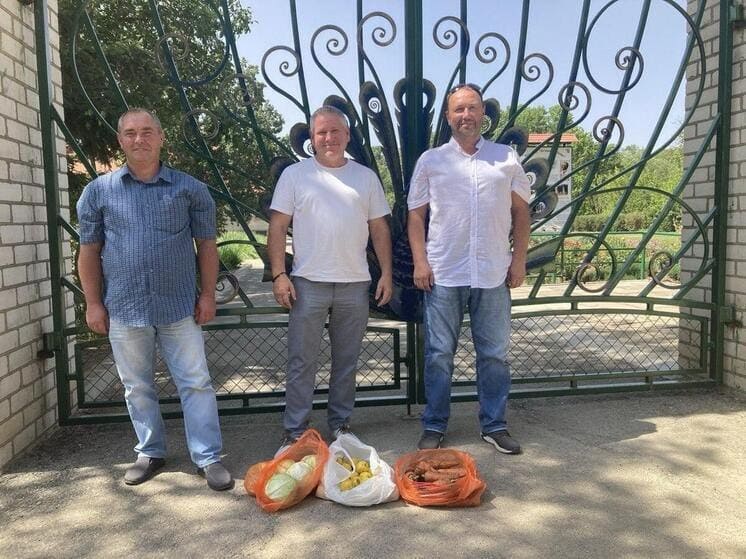
According to Shapoval, the ungulate collection at Askania-Nova numbers over 1,500 individuals and requires up to 10 metric tons of grain feed per month during peak seasons. In this context, symbolic vegetable parcels amount to little more than propaganda theater, creating an illusion of care while the animals continue to suffer from hunger and neglect.
Occupation or not, work goes on
The Ukrainian prosecutor general’s office estimates that losses from the illegal removal of animals run into hundreds of thousands of dollars. Several Ukrainian citizens are under investigation for collaboration in the scheme.
Shapoval complained that while international conservation treaties set procedures prohibiting the export of protected species, they lack effective enforcement when a state itself becomes the aggressor and violates the agreements.
“These documents were developed under entirely different circumstances,” he said. “No one could have imagined that a state party to international conventions might act as a terrorist and endanger the survival of protected natural areas.”
Despite the extremely difficult conditions, the Ukrainian Askania-Nova team continues to work and collect material documenting the crimes committed by the Russian occupiers. This evidence, intended to form the basis for future legal proceedings, is being submitted to the State Environmental Inspectorate, the Specialized Environmental Prosecutor’s Office and the Kherson Regional Military Administration’s Commission for Assessing Environmental Damage.
Shapoval was at pains to point out that even under current conditions, the reserve continues to function as a research institution.
“We must understand that Askania-Nova remains a scientific center,” he said. “Even if we have temporarily lost direct access to the site, our staff continue their work. We’re conducting research in related biotopes and carrying out field expeditions”.
He added that his team continues to publish the scientific journal Askania-Nova Biosphere Reserve Reports, first established in 1921. The publication features research articles on the reserve’s flora and fauna.
Askania-Nova needs Ukrainian victory
Today, Askania-Nova stands not only as a symbol of resilience but also as a tragic example of how the Russian occupation is devastating natural ecosystems and unique collections of international significance.
Animal theft, steppe fires, the loss of species and the destruction of infrastructure are all direct consequences of the occupiers’ actions. Russia must be held accountable for violating international norms and committing war crimes on the reserve’s territory.
Restoring Askania-Nova will require long-term, interdisciplinary work and substantial support—both from the Ukrainian state and from international partners committed to preserving its unique genetic heritage. Meanwhile, the reserve’s team must continue their scientific activities and systematically document every environmental crime committed by the occupation authorities.
Ultimately, all these efforts will have practical meaning only in the event of Ukrainian victory and the liberation of Askania-Nova from Russian occupation. Only then will it be possible to begin restoring Europe’s largest steppe reserve.
Translated by Alastair Gill
Main image source: TCH