
In early March 2026, apocalyptic scenes unfolded in Tehran, Iran. Following intense airstrikes on Iranian oil refineries and fuel depots, the capital was shrouded in thick, toxic smog. When soot, sulfur compounds and heavy metals released into the air by the fires entered the cyclone’s path, “black acid rain” fell on the city. Local residents reported severe air pollution that made breathing painful and caused severe irritation to the throat and eyes. The long-term health consequences could be particularly dangerous.
But while the “dark sky” over Iran remains on the front pages of global newspapers today, a longer and more exhausting environmental tragedy is quietly “choking” another part of the world. In Ukraine, where a full-scale war has been raging for four years, a new study has revealed the complex impact of the protracted conflict on the atmosphere.
The study, published by eight Ukrainian authors in the journal Environmental Science and Pollution Research, represents the first comprehensive multi-year analysis of how Russia’s full-scale invasion of Ukraine has physically altered air quality. Using a combination of data from ground-based monitoring stations and European satellites (Sentinel-5P TROPOMI), the researchers uncovered a paradox: in a country where the air has technically become “cleaner” due to the widespread destruction of factories and infrastructure—which consequently produce fewer emissions—sudden, extremely toxic spikes in pollution occur regularly, posing a serious threat to human health and the environment.
Immediate threat: toxic plumes and explosions
Researchers developed a new approach to analyze 255 confirmed cases where air quality deteriorated sharply immediately after an airstrike or other war-induced pollution. The results are alarming. On average, pollutant concentrations increased by 100–400% immediately after an attack. However, in some cases, these levels skyrocketed so high that they could be described as local environmental disasters.
For example, when an aerial bomb struck the “Izovat” mineral wool factory in Zhytomyr in March 2022, the local concentration of total suspended particulates (TSP)—solid and liquid particles suspended in the air (dust)—skyrocketed by 10,033%. Similarly, the drone and missile attack on Kyiv in August 2024 led to a surge in carbon monoxide (CO) levels of nearly 900%. Strikes on energy infrastructure and oil depots have repeatedly led to the release of massive plumes of sulfur dioxide (SO2) and nitrogen dioxide (NO2).
Inhaling these dense, but short-lived, clouds of toxic gas and particulate matter carries acute risks, especially for children, the elderly and people with respiratory diseases.
Long-term paradox: “clean” air at a devastating cost
An analysis of long-term regional data reveals a paradox. In many major Ukrainian cities, including Kyiv, Kharkiv, and Odesa, average levels of NO₂ and TSP have actually decreased by 10–30%.
Before the war, these areas were heavily polluted due to heavy traffic and large industrial facilities. Emissions have fallen following the destruction of infrastructure and industrial complexes. But this reduction in emissions is not a victory for the environment. As the authors note, these “reductions” come at a catastrophic human and economic cost—they are caused by the destruction of entire cities, the collapse of heavy industry and the mass migration of millions of refugees.
Dirtier fuel with a “blackout” effect
The use of strikes against the energy sector as a “covert” weapon has also led to a grim regression in air quality. As targeted missile strikes systematically destroyed Ukraine’s power grid, causing massive blackouts, citizens and businesses were forced to adapt. The result is the widespread use of thousands of diesel generators and the forced switch by surviving power plants from natural gas back to dirtier, highly polluting solid fuels, such as coal.
As a result, sulfur dioxide (SO2) emission levels have risen in the heavily affected central, eastern, and southern regions. In Kharkiv, the average SO2 level jumped by 69%, while in Kherson and Kryvyi Rih, increases of 32% and 27% were observed, respectively.
New geography of fires
The war has also fundamentally altered the physical landscape of fires in Ukraine. Satellite data on thermal anomalies reveal a striking shift. Prior to the 2022 invasion, fires in the country were primarily linked to traditional seasonal burning of agricultural waste. Today, agricultural burning is strictly prohibited. Instead, satellites capture a dense, bright band of thermal anomalies clustered directly along the front line—the result of relentless artillery shelling and drone attacks, which trigger large-scale, uncontrolled wildfires and forest fires.
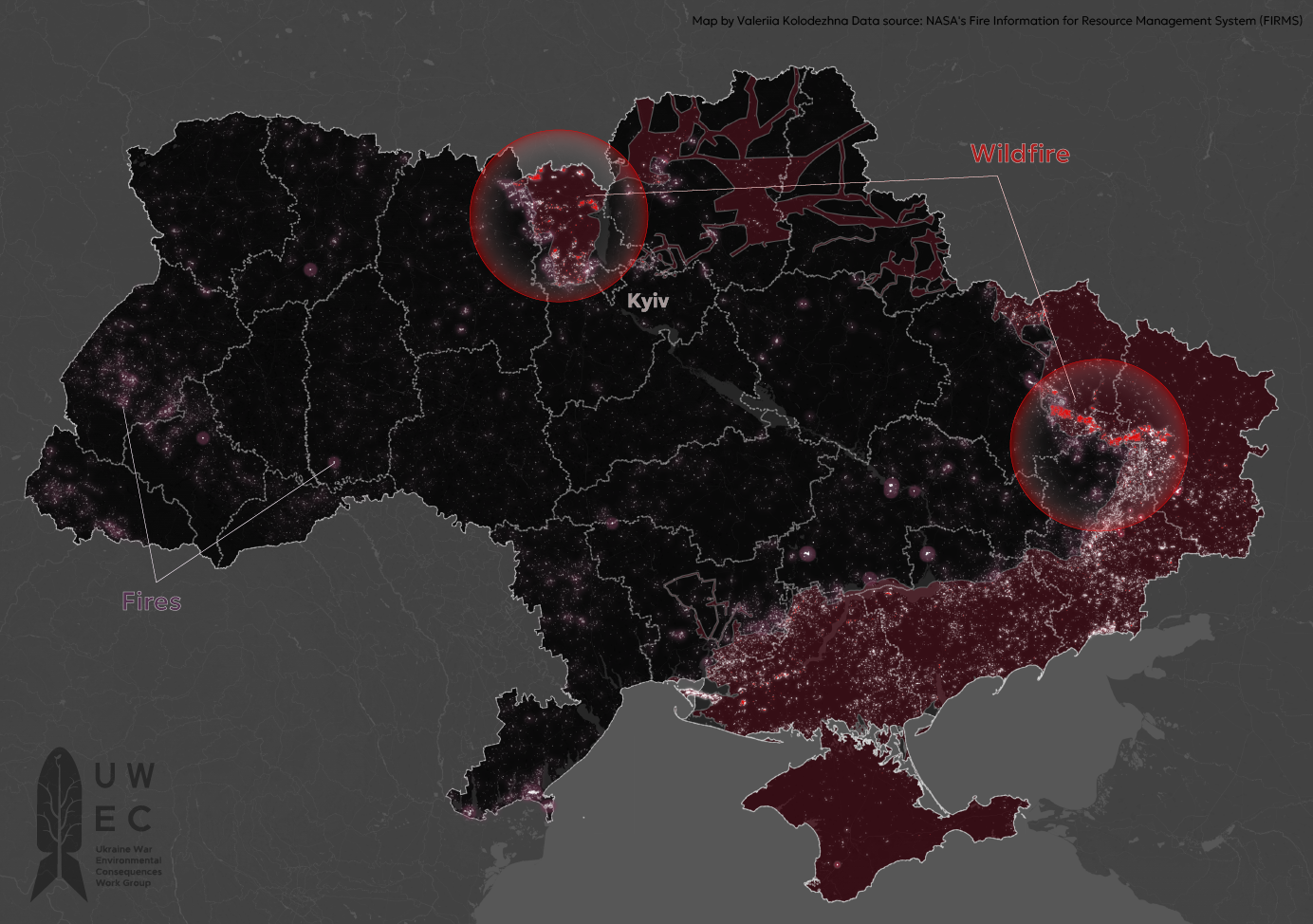
These fires release massive amounts of carbon monoxide and volatile organic compounds into the atmosphere, compounds which can travel long distances and act as precursors to ozone and aerosols. This not only degrades local air quality but also slowly destroys regional ecosystems, soils and water systems. It also has long-term climate impacts.
Recent studies from Ukraine demonstrate that war plays a treacherous role for the environment: it suppresses typical anthropogenic emissions through total destruction, only to replace them with irregular, hyper-toxic pollutants.