
History does not teach people well. Tragedies are forgotten, and power-hunger and hatred take over. Then the old questions arise again. Humanity has already thought about rebuilding ruined cities. It took 10 years to rebuild Stalingrad, 21 years to rebuild Warsaw, and in Dresden, the last ruined building, the Frauenkirche, was only restored in 2005.
But back then, the Soviet Union received reparations from Germany, and Europe received economic support under the American Marshall Plan. Now, especially with the arrival of Donald Trump, global solidarity does not seem so unbreakable. Moreover, it is unclear which country will ultimately control which ruined cities. As a result, it is also unclear what forces will be needed to rebuild them.
“In my opinion, full restoration of cities is no longer possible,” says Ukrainian ecologist and UWEC expert Oleksiy Vasyliuk. “All the settlements that were crossed by the front line have been completely or almost completely destroyed. At the same time, many of them are not just residential areas, but cities in which industrial enterprises occupy a dominant part of the area. To rebuild them, it is necessary not only to demolish the surviving walls and foundations, but also to dismantle the underground utilities. This includes not only sewage and water pipes, but also quite specific facilities, such as ammonia pipelines. Dismantling will be very costly, and at the moment it seems that it would be easier and cheaper to build new cities in new locations.”
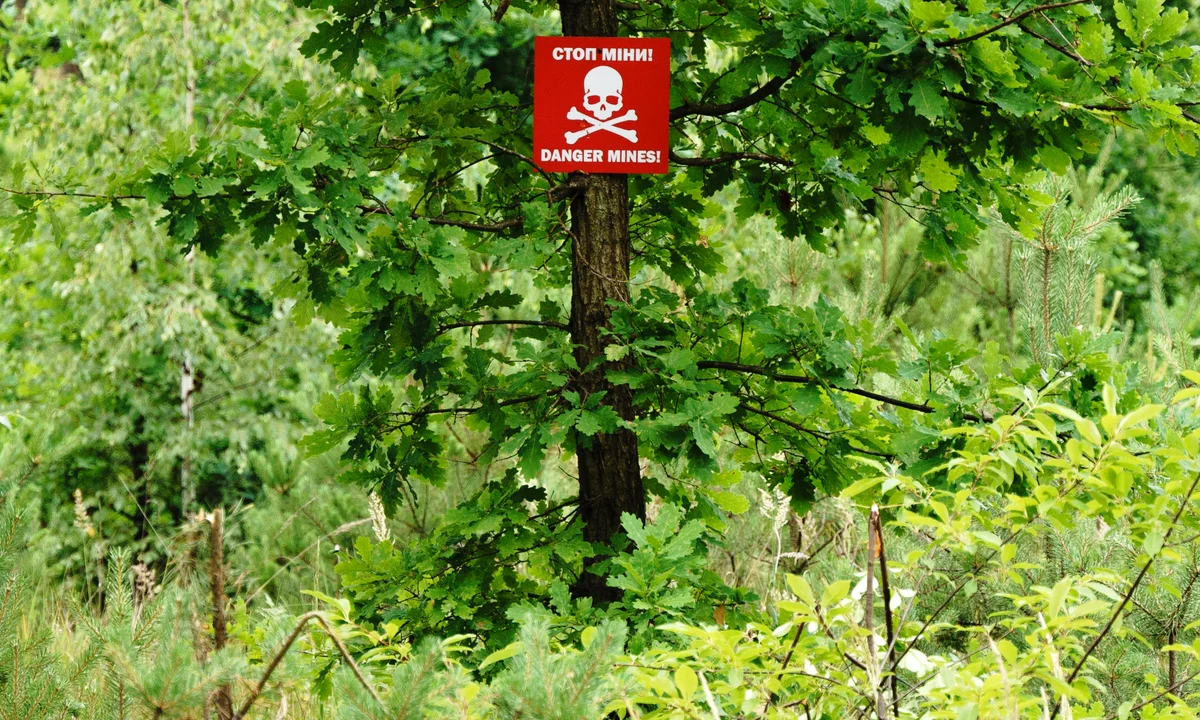
The expert points out that reconstruction will be hampered by the need for demining. In 2023, the Slovak analytical center Globsec estimated the mined areas in Ukraine at 67,181 square miles — slightly less than a third of the country’s territory. Based on this data, experts surveyed by The Washington Post estimated that even with 500 demining teams working on it, it would take up to 757 years to completely clear the mines.
“Of course, this figure seems exaggerated. But even if we assume that it will take ten times less time, who will wait 75 years before construction begins?” the expert notes. “Besides, the mines are currently lying in the grass, and it is clear how to defuse them. But what if trees start growing in these areas? I am sure that with each passing year, the time required for demining will increase rather than decrease. And there is a possibility that complete demining will not happen at all. Considering that the ruins of cities and their surroundings are among the most heavily mined areas, their restoration seems even less likely.”
In 2023, Ukraine introduced the DREAM electronic system, which brings together projects to restore infrastructure damaged by the fighting. Alexei Vasilyuk points out that most of these projects are planned to be implemented far from the combat zone. For example, there are 88 projects in the Donetsk region, while in the Kyiv region there are more than 400.
“In other words, we are talking more about repairing localized damage or even serious damage, as in Mykolaiv and Odesa, but not about cases where the city no longer exists,” the ecologist notes.
It is worth noting that DREAM does not, in principle, have any projects to rebuild settlements controlled by the Russian army.
“And one last thing. It is unclear whether the people who left these ruined cities themselves need reconstruction. Like many others, I initially had the illusion that those who left were waiting for an opportunity to return home. I remember the first few weeks when a huge number of displaced persons were living wherever they could. I was also a displaced person, and I remember how thousands of people with children slept on mattresses in the train station building in Lviv during the winter. At the time, it seemed that these people had been left homeless, with nowhere else to go, and that something needed to be done so that they could return,” says Oleksiy Vasyliuk. “But that was almost four years ago. Since then, millions have left for Europe, and some have settled in other regions of Ukraine. And it is not at all certain that they will want to return to where they used to live. Especially considering that reconstruction will take years, if not decades.”
Another UWEC expert, Eugene Simonov, believes that there will still be people who want to return.
“And, in my opinion, there will be many of them. There are emotional reasons for this — their native places and calculations: people in these ruined cities have real estate on paper, and this is an asset,” says the expert. “But more importantly, there is the inertia of bureaucracy, which still lists the city here. Moreover, at the very first conference on reconstruction, Balkan experts [appealing to their own experience] explained that there are many interested parties in the reconstruction of ruined cities: huge contracts, a huge number of lobbyists, the most expensive solutions, which are often completely unnecessary. In other words, reconstruction is a kind of huge grant competition. And this must also be taken into account.”
From an article in Novaya Gazeta
Recent posts:
- Building Back Business as usual: Can the Rapid Damage and Needs Assessment provide strategic planning support for green rebuilding of Ukraine?
- LNG dependency poses a risk to Europe’s climate ambitions
- Four years of full-scale war in Ukraine: the environmental perspective
- Russia’s attacks on vegetable oil facilities open a new front in its war on Ukraine
- Fiber-optic web: How the use of drones on the frontlines impacts the environment