Eugene Simonov
Russia has been destroying Ukrainian oil facilities since it launched its full-scale invasion in 2022, but Ukraine is now hitting back, forcing Russian media to finally recognize the environmental and social consequences of such strikes—but only in Russian territory. UWEC looks at the history of attacks on oil infrastructure in wartime and the gaps in international law that make bringing aggressors to account so difficult.
Until 2026, the environmental costs of Russia’s full-scale invasion were far less pronounced for Russia itself than for Ukraine. In addition, there is still no reliable data on environmental consequences in Russia in the public sphere, nor are there any opportunities for transparent public monitoring. In 2026, however, the situation has changed—the impact of strikes on Russian oil infrastructure has reached an unprecedented level, and their consequences are now being openly discussed in the Russian public space.
After repeatedly suffering from all-out Russian missile attacks, Ukraine has finally managed to establish systematic counterstrikes on the enemy’s circulatory system—Russia’s oil production and export infrastructure. The downside of this military success is the significant negative environmental and reputational consequences of fires and oil spills caused by these attacks. And although responsibility for the humanitarian and environmental damage for this war falls squarely upon Russia as the aggressor, nonetheless, in this author’s opinion, the impact of the war on its territory should be carefully documented and ways should be sought of reducing harm to natural ecosystems and the civilian population.
Oil wars of the past
Attacks on the enemy’s oil industry facilities are nothing new in military history. As far back as World War I, in December 1916, a team of British engineers during a ground operation destroyed Romanian oil fields and refineries near the city of Ploiești in the face of advancing German and Austro-Hungarian troops. Around 800,000 tons of oil were burned and dozens of refineries destroyed as a result of the destruction.
In World War II, refineries in the same Ploiești, which had supplied Germany with a third of all its oil products, became the target of an Allied operation to deprive the enemy of fuel in 1941-1943. As part of Operation Tidal Wave, August 1, 1943, around 180 American B-24 bombers carried out successful attacks on nine refineries around Ploiești. In turn, Germany, in an attempt to disrupt supplies of fuel to the Allied armies, actively used submarines to sink hundreds of tankers. On May 5, 1942, the American steam-powered oil tanker Munger T. Ball, en route from Texas to the state of Virginia with a cargo of 65,000 gallons of gasoline, was hit by two torpedoes from the German U-boat U-507 and quickly sank around 80 miles northwest of Key West in Florida. Remarkably, an oil sheen was found on the surface of the ocean in this region as recently as 2021, after which an operation was carried out to pump petroleum out of the sunken vessel’s tanks.
The environmental impact of military operations against the oil industry has been well studied in Middle East conflicts, from the Gulf War in 1991 to the US-Israeli war on Iran in 2026.
In early 1991, Iraqi troops retreating from Kuwait blew up more than 800 oil wells, of which over 600 caught fire. Data from the International Institute for Applied Systems Analysis (IIASA) shows that up to around 355,000 tons and 35 million cubic meters of oil and gas burned up each day in oil fires, respectively. Sulfur dioxide emissions are assessed at around 24,000 tons per day.
The soot did not spread over large areas, but settled through rain and dew, mainly over the northern part of the Arabian Peninsula. The large volume of particulate matter in the air had a noticeable effect on the local climate and for several months the temperature was 10 degrees Celsius lower than in typical years.
The oil from oil wells formed a network of oil rivers and lakes with a total volume of 10–20 million tons. That oil subsequently seeped into the ground to various depths. It is calculated that 1 — 1.7 million tons of oil spilled into the sea and polluted 700 kilometers of coastline in Saudi Arabia, Kuwait, Iran, Bahrain and Qatar.
The spill also destroyed a large area of mangrove forests and marshland along the affected coastline. Between 50 and 90% of crabs, amphipods and mollusks also perished. Marine and coastal birds suffered from direct pollution of their feathers with oil and as a result they ingested the toxic substance, mainly when cleaning their feathers.
According to the IIASA, between 22 and 50% of the populations of several species of cormorants and grebes perished as a result of the spill. Around 100,000 sandpipers died directly or indirectly as a result of the 1991 oil spill. Roughly ten years later, decaying oil that had been preserved in the ground was still appearing on some beaches. It was the largest disaster of its kind in human history.
In comparison with the “apocalypse” of 1991, the US and Israel’s attack on Iran in March 2026 has so far had a limited effect in terms of environmental consequences, judging by currently available data. Selected gas fields, storage facilities and terminals were attacked, but there were no massive oil well fires, nor did hundreds of thousands of tons of oil leak into the environment. The main environmental damage has been caused by localized fires and toxic black sediment in Iran, but the scale is significantly smaller than in 1991. Nonetheless, air pollution endangers the health of millions of Iranians, as well as the inhabitants of neighboring Arab countries targeted by retaliatory strikes. Marine pollution resulting from strikes on individual vessels was fortunately localized.
Strikes on Ukraine
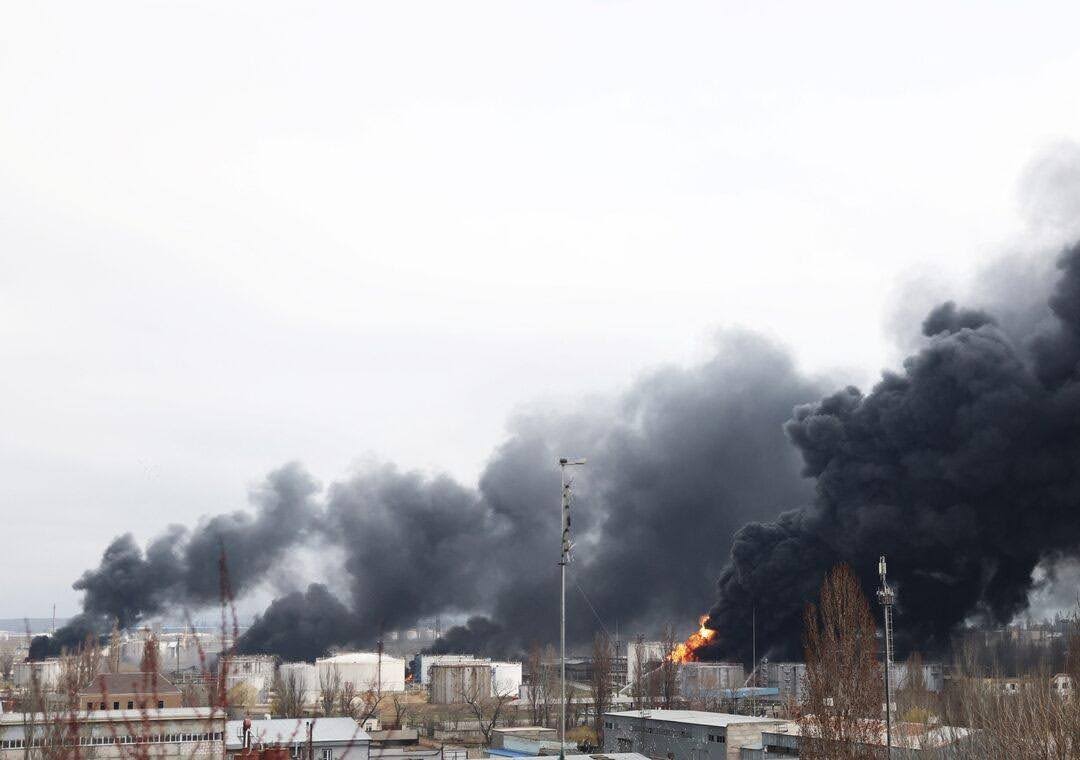
The destruction of Ukraine’s oil and gas industry and infrastructure has become one of the Russian army’s top priorities, as a number of examples illustrate.
During the night of February 26, 2022 Russian strikes set fire to an enormous oil storage facility in Vasylkiv—practically a suburb of Kyiv. That same morning, the Center for Strategic Communications and Information Security issued instructions to the public on how to protect themselves from toxic pollution resulting from the fire and smoke. Local residents—and most importantly, firefighters—already had experience dealing with fires of this nature. Back in 2015, a vast fire—the largest to have ever hit Ukraine’s oil infrastructure—broke out at the same oil depot, destroying two-thirds of the facility.
A month after the attack on Vasylkiv, a new missile strike on an oil depot on March 26, 2022 near the village of Velyki Kryvchytsi in the Lviv region caused a fire, leading to massive air pollution.
The mass attacks of April 2–3, 2022 on the Kremenchuk and Odesa refineries, thermal power plants and several oil depots were the first major operation to deliberately destroy elements of Ukraine’s fuel and energy infrastructure.
In late fall 2022 the Russian army concentrated on the widespread destruction of heating and power supply facilities in Ukrainian cities, including oil and gas storage sites, fuel transportation infrastructure and thermal power plants. This approach of attempting to “freeze out” the urban civilian population continued during each subsequent winter.
On November 17, 2022, a Russian missile attack in eastern Ukraine damaged gas extraction infrastructure of Ukrgazdobycha, the country’s biggest gas producer.
According to American toxicologists, 36 fuel storage facilities were destroyed in the first 13 months of Russia’s full-scale invasion of Ukraine. The resulting emissions resulted from the burning of 108,000 tons of oil, oil products and petroleum.
On April 11, 2024, Russia first carried out a combined attack on two underground storage facilities belonging to the Naftogaz corporation in the Lviv region, resulting in damage to the facilities’ external infrastructure, but not to the underground containers themselves.
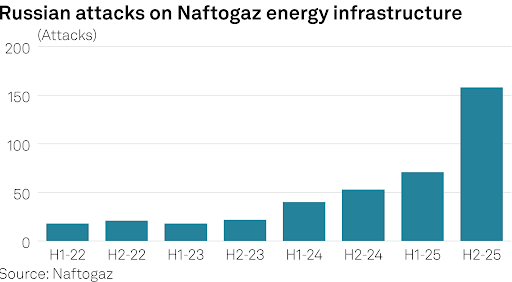
Infrastructure connected to oil and gas pipelines transiting Ukraine (Bratstvo gas pipeline, Druzhba oil pipeline, etc.) only escaped such targeted strikes while they supplied Russian exports to Europe. Ukraine’s refusal in 2025 to continue transit of Russian gas led to a sharp intensification of attacks on facilities belonging to Naftogaz. While the company’s sites were attacked 172 times from 2022 to 2024, in 2025 the company recorded 229 attacks.
Since the full-scale invasion began, the country’s entire oil-refining infrastructure has been destroyed, and gas extraction has fallen by 40%. Today Ukraine is forced to import 100% of the oil products it needs and has increased its gas imports several times over.
The destruction of Ukraine’s fuel and energy sector, including the oil and gas industry, has become one of Russia’s most effective tools in its war of aggression, both in terms of undermining the Ukrainian economy and inflicting psychological pressure on the civilian population. In 2026, Russia continues to carry out its intensive attacks on oil and gas facilities under repair, as well as related infrastructure.
The environmental impact of Russian attacks: Kremenchuk
One of Ukraine’s most important oil facilities, the Kremenchuk refinery (with a capacity of 18 million tons of oil annually) has been attacked more than 300 times between 2022 and 2026, but only in 2025 were its processing capacities completely disabled. On May 5, 2026 the factory once again became the target of a mass missile attack, as a result of which a repair team of five people was killed.
According to a study of the socio-ecological consequences of attacks on the Kremenchuk oil refinery between April 2022 and September 2023 (CEOBS, 2024), these attacks did not lead to fatalities, but several people received burns. Particulate matter, nitrogen oxides (NOx), sulfur dioxide (SO2) and volatile organic compounds (VOCs), including formaldehyde, as well as dioxins, furans and black carbon, were released into the atmosphere and soil. Damage to the electrical substation poses a particular toxicological hazard, since insulating oils may contain polychlorinated biphenyls, which can convert into highly toxic dibenzofurans and dibenzodioxins when burned.
The risk to civilian health has only been exacerbated by the fact that the population of Kremenchuk has increased by a third due to arriving refugees. The situation is complicated by secondary pollution from fragments (e.g., asbestos) and the use of foam containing “persistent chemicals” (per- and polyfluoroalkyl substances, or PFAS) to extinguish fires. Smoke spreads toxic particles, which settle on and pollute the soil, which can lead to a secondary pollution of water and agricultural cultures. If the territory of the oil reservoir is not properly protected with berms, then oil products can also spill into the surrounding lands and water bodies.
On the whole, this picture of environmental and health consequences is typical for fires at oil storage facilities and applicable to many other cases of attacks on oil infrastructure, both in Ukraine and in Russia.
The relatively small scale of the oil refining industry and storage facilities in Ukraine meant that their almost complete destruction by Russian missile attacks, which have brought extremely negative, but relatively local environmental consequences, attracted less public attention amid the vast environmental damage caused by Russia’s invasion of Ukraine. In a way, Ukraine’s lack of oil resources is a blessing.
What kind of air are people breathing in areas affected by oil fires?
The most hazardous substances for humans released during oil combustion can be divided into several groups. Here are the main ones, indicating the means of exposure and impacts upon health:
1. Carbon monoxide (CO)
- Why it is dangerous: Binds to hemoglobin in the blood 200–300 times stronger than oxygen, causing hypoxia (oxygen starvation of tissues).
- Symptoms: Headaches, dizziness, nausea, loss of consciousness, death (concentrations in excess of >0.1–0.2% can lead to death within minutes or hours).
- One of the main causes of human death during fire at oil facilities.
2. Benzene (C₆H₆) and other volatile aromatic hydrocarbons (toluene, xylenes, ethylbenzene)
- Why they are dangerous:A known carcinogen, they cause leukemia and other blood cancers. They also affect the nervous system and bone marrow.
- Acute effects: Dizziness, confusion, convulsions.
- Chronic effects: Anemia, immunosuppression, cancer (even at low concentrations over long periods of exposure).
- Released in large quantities during combustion of gasoline and light fractions of oil.
3. Polycyclic aromatic hydrocarbons (PAHs) – benzo(a)pyrene, naphthalene, etc.
- Why they are dangerous: Strong carcinogens (benzo(a)pyrene — group 1). Causes lung, skin and bladder cancer.
- Also: They act as mutagens and tetragens (harmful to fetuses), and damage DNA.
- Formed during incomplete combustion. Found in especially high density in black smoke from mazut and heavy petroleum products.
4. Dioxins and furans (PCDD/PCDF)
- Why they are dangerous: The most toxic organic substances (they have a toxicity thousands of times higher than that of cyanides).
They accumulate in the body, causing cancer, endocrine disorders, immunodeficiency and reproductive problems.
- Formed during combustion of chlorine-containing impurities or in the presence of metal catalysts (very dangerous even in small quantities).
5. Hydrogen sulfide (H₂S)
- Why it is dangerous: A highly toxic nerve agent that blocks cellular respiration more effectively than carbon monoxide.
- Symptoms: A smell of rotten eggs (at low concentrations), at >100–H₂S they cause an instant loss of smell and a “switching off” of the protective reflex, convulsions, respiratory and cardiac arrest.
- Produced in especially high density during combustion of sulfurous (“sour”) oil.
6. Sulfur oxides (SO₂, SO₃) and sulfuric acid in aerosol
- Why they are dangerous: They cause severe irritation of the respiratory tract, pulmonary edema, and bronchospasm. When deposited via precipitation, they cause acid rain.
- Chronic effects: asthma, chronic respiratory diseases, cardiovascular diseases.
7. Nitrogen oxides (NO, NO₂)
- Why it is dangerous: Strong pulmonary irritant, causing delayed pulmonary edema (up to 24–48 hours). Converts to nitric acid, causing acid rain.
- Chronic effects: respiratory diseases, decreased immunity.
8. Fine particulate matter (PM₂.₅ and PM₁₀) + soot (black carbon)
- Why it is dangerous: Penetrates deep into the lungs and bloodstream, causing inflammation, atherosclerosis, heart attacks, strokes, lung cancer. Soot is an additional carcinogen.
- Particularly dangerous when inhaled for long periods of time.
Brief hazard rating for acute exposure in fire zones
- H₂S (can kill in seconds or minutes)
- CO (the main cause of death during fires)
- Benzene + PAHs + dioxins (carcinogens—main long-term threat)
- NO₂, SO₂ (pulmonary edema, acid rain)
- PM₂.₅ + soot (cardiovascular and respiratory risks)
Attacks on oil and gas facilities: gaps in international law
According to assessments by CEOBS and the European Center for Constitutional and Human Rights (ECCHR), the application of international law comes into conflict with the fundamental problem of the “triple threshold.”
According to Additional Protocol I to the Geneva Conventions and the Rome Statute, environmental damage is recognized as a war crime only in cases where it is simultaneously “widespread, long-term and severe.” In legal practice these terms are interpreted fairly broadly: “widespread” can mean an area of thousands of square kilometers, and “long-term” — decades. “Severe” damage must be substantially more severe than “normal” damage sustained in the course of military action. The majority of attacks on refineries or oil terminals, despite their catastrophic local effect, rarely reach this collective threshold, which makes current regulations practically ineffective at protecting the environment during real military action.
The second major barrier is the principle of “military necessity” and the balance of proportionality. International humanitarian law permits serious harm to the environment, as long as it is not “excessive” in relation to the anticipated military advantage.
Since energy infrastructure directly feeds military logistics, parties to a conflict can always justify strikes on fuel facilities by invoking the need to undermine the enemy’s combat capability. The vagueness of the definition of “concrete and direct military advantage” in the Rome Statute allows for the legalization of large-scale pollution, effectively turning environmental consequences into an unfortunate but acceptable side-effect of war.
These complications are compounded by a fragmented legal framework and political decisions made by states. In 2019, for example, Russia withdrew its recognition of the jurisdiction of the International Humanitarian Fact-Finding Commission for Additional Protocol I to the Geneva Conventions. The status of the International Criminal Court (ICC) remains ambiguous, as neither Russia nor Ukraine are full parties to the Rome Statute (although Ukraine has recognized its ad hoc jurisdiction). The ENMOD Convention (Convention on the Prohibition of Military or Any Other Hostile Use of Environmental Modification Techniques) is also of limited application, since it regulates intentional modification of the natural environment (the causing of earthquakes or tsunamis), rather than pollution resulting from the destruction of industrial facilities. All of this leaves attacks on oil refineries in a “gray area” where international law is concerned.
In today’s world, even progressive concepts such as the “right to a healthy environment” or the recognition of ecocide still fail to provide a viable mechanism for reparations. Although the criminal codes of both Ukraine and Russia contain provisions on ecocide, the concept is only now beginning to take shape at the international level.
Climate agreements, including the Paris Agreement, also contain no mechanisms relating to responsibility for emissions (reaching millions of tons of CO2) caused by military actions on foreign territory. Nonetheless, at the COP 30 conference in Brazil, Ukraine went ahead and announced plans to bring Russia to justice for greenhouse gas emissions linked to its war in Ukraine. The Ukrainian government will file a claim under the “Environmental Damage” category of the Register of Damage for Ukraine, which is part of the International Claims Settlement Mechanism.
Given the social cost of carbon at $185 per ton of CO₂, a report published by the Ukrainian NGO Ecodiya estimates the total climate damage claim at $57 billion as of February 2026. The destruction of energy facilities in Ukraine accounts for only 6% of the total emissions. Yet if the aggressor state, the Russian Federation, were to file a similar counterclaim, emissions produced by the destruction of energy facilities would surely be the largest component in their filing.
Overall, the lack of clear international criteria for assessing cumulative damage and the prioritization of tactical military gains over environmental safety make pursuing legal action for attacks on the oil and gas sector extremely difficult for both sides.
Lawyer Alexandra Harrington of McGill University also believes that there is a critical omission in the (Chemical Weapons Convention (CWC), 1997) and numerous international agreements on toxic substances: they do not cover toxic pollution from the destruction of petrochemical and other hazardous production facilities and storage facilities, even though the consequences could be equivalent to the use of chemical weapons.
In the current situation, then, it is not international law that works against the attacking party, but reputational damage. If a party’s actions appear barbaric in the eyes of the international community, many countries will try to distance themselves from the aggressor or even levy sanctions against it.
Bleeding Russia’s oil industry dry
According to Russian independent media outlet Verstka, during the first four years of the war, Ukraine carried out at least 281 attacks on oil refineries and oil depots in Russia and occupied territories. At least 230 of these attacks (82%) were successful.
The Ukrainian armed forces attempted to hit Russian oil refineries and oil depots 18 times in 2022, 27 times in 2023, 94 times in 2024 and 152 times in 2025. In 2026, Ukraine has already carried out over 100 attacks and it is increasingly seeing the effect of such operations, both in military and propaganda terms.
These strikes have a significant impact on fuel supplies to Russia’s war machine, as well as on the entire Russian oil export chain, and call into question the reliability of Russia’s long-term oil contracts. They effectively complement (or even replace) the impact of international sanctions on purchases of Russian oil.
“Strikes on the oil sector are one of few chances for Ukraine to inflict relatively significant damage on huge Russia with a small number of strikes, in order to force it to seek an end to the war,” argues UWEC Work Group expert Oleksiy Vasyliuk.
“The vast oil and gas sector is a powder keg, and the aggressor-state is sitting on it. In terms of self-defense, the logical choice for Ukraine is to set fire to it. The environmental consequences, although significant, are distributed across the vast territory of European Russia and the Urals,” he says.
The environmental consequences of major Ukrainian strikes on Russian oil refineries are generally similar to those recorded in Kremenchuk, but until the spring of 2026, there was no official data available from Russian agencies, or independent assessments from witnesses on the ground.
Russian authorities minimized reports on such incidents, claiming no serious damage or casualties, occasionally noting burning oil spills but failing to report the concentration of toxic substances in the air. Nonetheless, some sources indicate that Samara and Orsk—cities located near oil complexes repeatedly damaged by Ukrainian strikes—were the two worst spots for high and extremely high air pollution in Russia in 2025. The number of extreme pollution incidents has increased by 41% in the last year. The largest share of detected incidents (69%) involved hydrogen sulfide emissions, which are typical of oil fires.
Detailed descriptions of “oil/black rain” and the appearance of disturbing smells only appeared en masse on social media and in the Russian press in late April and early May 2026, for example, following the fire at the Lukoil-Permnefteorgsintez oil refinery (April 29–7) and Rosneft’s Ryazan oil refinery (May 13–15). The authorities in these regions allowed the partial closure of kindergartens and even recommended that residents should leave their homes as little as possible.
Why is Tuapse being treated as an environmental disaster?
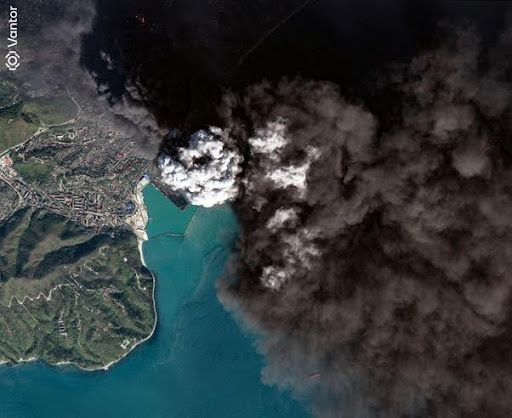
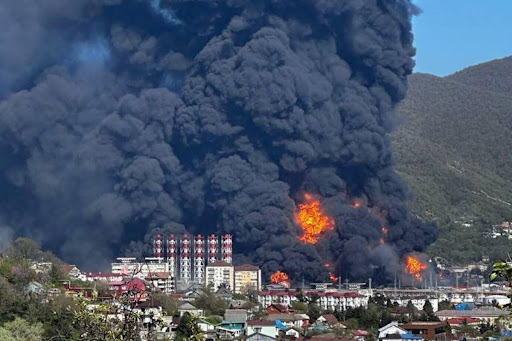
The Ukrainian attack on the Tuapse oil refinery was a turning point in media coverage of the environmental consequences of military action on Russian territory.
Rosneft’s compact export terminal on the shore of the Black Sea was a convenient military target, although it was not the most important in terms of hitting Russia’s export capacities. The oil-loading capacity of neighboring Novorossiysk is many times higher.
Nonetheless, in the course of the war Ukraine’s armed forces have attacked the Tuapse oil refinery more than 10 times. Successful attacks that caused fires took place on February 28, 2023, January 25 and July 22, 2024, March 14 and November 2, 2025, around December 31, 2025, April 16, 20 and 28 2026, as well as May 1-2, 2026. Over the years, Ukrainian attacks on Tuapse have taken place with increasing frequency and intensity, but until April 2026 we had heard nothing about the environmental consequences.
The last series of four mass attacks resulted in fires that burned for many days, the leaking of oil products into the sea, and “oil rain” containing products of combustion. For the first time, the authorities admitted to levels of toxic substances (benzene, xylene, polycyclic aromatic hydrocarbons, soot) exceeding the maximum permissible concentration. They also recognized the potential cost to tourism in a region popular with Russian vacationers. This all made this particular catastrophe one of the most noteworthy environmental disasters of the war.
Throughout the year, however, the Ukrainian armed forces carried out a no less painful series of strikes on other targets, strikes that are likely to have resulted in similarly severe environmental consequences. So the negative impacts in the small resort town of Tuapse, while very intense, do not explain the widespread attention paid to this particular incident by international and Russian media. And they certainly don’t explain why the Russian authorities permitted all these media outlets and bloggers to report directly from the site of the disaster.
The Black Sea coast is seen by Russians as something of a sacred place, as demonstrated by the reaction to the fuel oil spill in the Kerch Strait in December 2024. Thousands of people rushed to help from across the country, making it the most publicized and sustained campaign organized by Russian civil society since the full-scale invasion. The state is now forced, through gritted teeth, to encourage coverage of peaceful civil actions aimed at saving Tuapse from pollution. Volunteer rescuers are hardly flocking to Ryazan, Perm and Orsk, although these cities certainly need help as well.
In early April 2026, a new oil spill occurred in the sea off neighboring Anapa, stirring up civil society and the media. Two weeks later, the fire and spill in Tuapse further inflamed passions and provided an opportunity for people who had been forbidden from voicing their dissatisfaction for the last four years to finally give vent to their emotions. In the eyes of the authorities, anyone who speaks out against environmental pollution, which has apparently become acceptable in Russia, is also automatically opposed to the war itself, which has become increasingly tiresome for the Russian middle class. Ahead of upcoming State Duma elections, the authorities do not have cause to prohibit citizens from providing assistance to those affected by the environmental disaster in Tuapse. After all, it was clearly caused by the Ukrainians, a fact which can be emphasized in state propaganda.
Hesitant to ban the expression of popular discontent over the environmental consequences of the war, the authorities decided to capitalize upon it instead. On April 28, 2026, during a meeting on election security, Vladimir Putin stated that “the attacks on energy facilities in Tuapse… could potentially cause serious environmental consequences… [but everything is under control and our people will deal with it].”
This is the only time in the entire war that Putin has made any clear public acknowledgement of the potentially serious environmental consequences of Ukrainian strikes against Russia. The president’s statement made it relatively safe for bloggers, journalists, officials and politicians to publish information about the environmental consequences of Ukrainian strikes. This explains why, post-April 28, Russian reports on the aftermath of many attacks started to include an environmental angle. The authorities also began issuing health advisories to residents of areas hit by Ukrainian drone attacks—in the case of Tuapse, 12 days after a suffocating smog appeared.
The last important factor in the escalation of strikes on Russian oil infrastructure has been the US-Israeli war on Iran. The “temporary” loosening of American sanctions on buyers of Russian oil prompted Ukraine to take immediate action to reduce Russia’s export capacities using attacks on export terminals.
On the other hand, in March 2026, during the US-Israeli attacks on Iran, there were attacks on four oil depots in the suburbs of Tehran, which obviously led to harsh consequences for the health and well-being of the civilian population, and used rather as a means of intimidation than for the achievement of military superiority (for example, see the analysis by lawyer Lizaveta Tarasevich from the Geneva Human Rights Academy). Human Rights Watch, Amnesty International, the UN Environment Programme and many other international institutions have expressed their deep concern about the humanitarian and environmental consequences of these attacks for the civilian population.
Yet, in spite of the broad discussion, an attack like this, orchestrated by the “leader of the western world”— the USA, normalizes the practice of “environmental war.” It nudges global public opinion toward the acceptance of deliberate social and environmental damage as an integral part of contemporary warfare. It is important to note, however, that the world’s media can no longer permit themselves to ignore the environmental catastrophe caused by the Ukrainian attacks on the Tuapse oil refinery, having already published detailed coverage of the suffering of Iranian civilians from fires and oil rain a month earlier.
The lesser of two evils?
War shines a harsh and unflattering light on the fact that environmental consequences count for relatively little in military decision-making. Normalization in the public consciousness of inflicting large-scale environmental harm on the enemy as a necessary means of achieving military goals is a very alarming trend. But the choice facing the military is often one between bad and terrible.
“It’s possible that assessing the environmental consequences really doesn’t play a big role in the Ukrainian armed forces’ decision-making,” says UWEC Work Group expert Oleksiy Vasyliuk. “But most Russian strikes hit apartment buildings and it is obvious that the goal of such strikes is to sow terror through the death of civilians. Against this backdrop, the Ukrainian armed forces’ strikes on fuel tanks and pipelines are seen as the actions of a country that is trying to defend itself, trying to halt the Russian war machine, while not stooping to the systematic annihilation of civilians.”
The heinous situation in Tuapse has one clearly instructive effect: more and more Russians are beginning to understand that the war is now taking place on their territory and is now destroying “their” nature. Where empathy for others was previously lacking, a healthy selfish interest is now awakening, along with an understanding that the only alternative to mutual destruction is peace, and strikes on fuel and energy facilities will end only in the case of an end to the war or an extended ceasefire.
Translated by Alastair Gill
Main image: A Black Sea beach Source: Yandex Zen