By Oleh Savytskyi
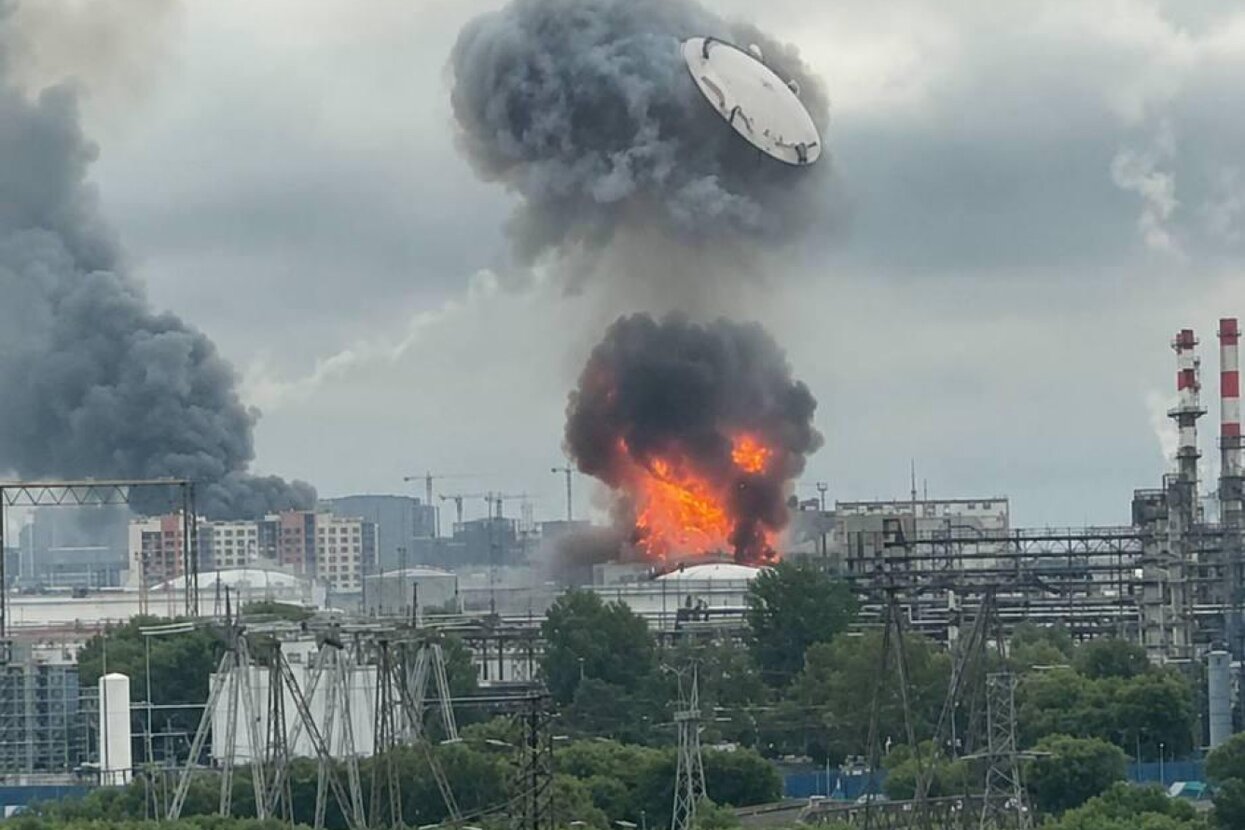
The “oil rain” that fell over Moscow after the partially self-inflicted blasts at the Gazprom Neft refinery is a disturbing image of what fossil fuel infrastructure means in wartime. Burning oil tanks, toxic smoke, contaminated precipitation and risks to soil and water are real environmental harms. They should not be dismissed. But they also should not obscure the larger truth: the biggest environmental threat is not a refinery fire. It is Russia’s unlimited fossil fuel extraction model, which serves as an economic basis for anti-humane and anti-environmental “petrofascism”.
Four years of Russia’s full-scale war and Europe’s current scorching heatwave point to the same old truth: Russia’s oil must be kept in the ground. The Kremlin-controlled fossil fuel industry is not only a source of war revenue, but also a driver of the climate crisis. When Ukrainian strikes disrupt the operations of Russian refineries, depots and oil export routes, they expose the fragility of a petrostate built on endless extraction. The environmental and climate protection question is therefore not only what burns today, but what must never be extracted tomorrow: every barrel of Russian oil kept underground means less war money, less long-term fossil fuel infrastructure lock-in, and less carbon added to the atmosphere of an already overheated planet. This is why, with support from many partners in Europe and across the globe, Razom We Stand doubles down on efforts to end international trade of Russian oil and gas and pushes for an electrified and renewables-based energy future.
Although the localized environmental damage induced by Ukrainian strikes is considerable, the curtailing of Russian oil production and exports may significantly reduce chronic pollution and the frequency of major disasters, such as the oil spill in Kerch Strait in December 2024. The wreckage of two “Volganeft” tankers that polluted up to 1000 kilometers of coastline and killed thousands of birds and millions of underwater creatures resulted from corrupt functioning of Russia’s oil-export machine. The Russian government’s lack of capacity and political will to clean up pollution and control the safety of oil transportation in the aftermath of this transboundary catastrophe suggests that the next major spill is just a matter of time. More disasters are to come if Russia is allowed to continue to produce and export oil and find unscrupulous buyers at everyone else’s expense.
Choked with crude oil
Russia’s oil and gas sector turns natural resources into multi-billion-dollar profits that fund the country’s war of aggression against Ukraine, political destabilization abroad and repression at home. It also continues to feed the global climate crisis. If oil stored in oil tanks and depots had not burned during Ukrainian attacks, it would likely have been refined, exported or consumed anyway, producing financial returns for the Kremlin and adding more carbon to the atmosphere.
Reuters reported that Moscow’s key oil refinery is unlikely to resume operations before 2027 after being hit twice by Ukrainian drones. The plant used to process 11.6 million tonnes of crude oil annually and was producing millions of tons of gas and diesel. Its shutdown is not only symbolic. It blocks a significant downstream piece of Russia’s domestic fuel system at a time when pressure to limit upstream production is mounting.
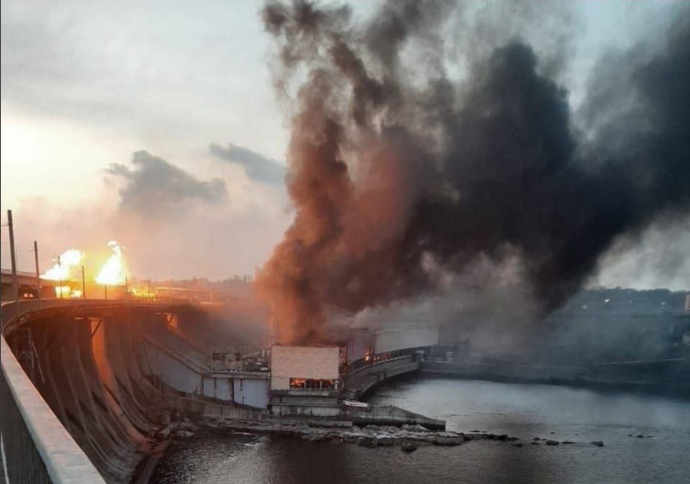
The same applies more broadly. Ukrainian strikes have repeatedly hit refineries, depots, export terminals, pipelines and pumping stations. Around a fifth of Russia’s oil export capacity was offline following attacks on port infrastructure, pipelines and refineries. Key export terminals in the Baltic and Black seas had to suspend crude oil exports after drone strikes and fires. Industry sources described Russia’s pipeline system as “choked with oil,” with storage filling up, and some fields were forced to limit production back in spring.
The positive climate effect begins when repeated disruption changes the operation of Russia’s oil system: less refining capacity, fewer reliable export routes, more pressure on storage, and ultimately lower upstream production. This is exactly why recent developments are strategically important.
Russia is no longer the “gas station” of the world
When refineries cannot process crude and export terminals cannot reliably load it, the system also gets choked upstream. Production must eventually be curtailed. Moscow has tried to manage this by redirecting more crude to exports. In May, western port exports rose as refinery outages pushed more crude toward Primorsk, Ust-Luga and Novorossiysk. Yet, Russia’s export capacity is limited and cannot accommodate all the crude that is no longer being processed domestically. In other words, the system can shift pressure from refineries to ports, but it cannot eliminate the bottleneck.
There is already evidence that the shockwaves have stretched to crude oil extraction. Recent reporting based on OPEC and Bloomberg data shows Russian crude and condensate production was falling to around 9.0 million barrels per day in May, down roughly 370,000 barrels per day from November. This does not mean every lost barrel is caused only by Ukrainian strikes. Sanctions, investment constraints, OPEC+ limits, maintenance and market conditions also matter. But the direction is clear: attacks on oil infrastructure are no longer only creating temporary outages. They are contributing to structural constraints on Russian oil production.
The immediate purpose of Ukraine’s strikes on oil infrastructure is military and economic: to weaken Russia’s ability to finance and sustain aggression. But the long-term effect may be broader and far-reaching. Ukraine is also exposing the fragility of Russia’s extractive economic model built on oil and gas.
The overlooked climate dimension
The world already has far more fossil fuel reserves than can be safely burned. Scientific estimates show that to keep global warming at bay, a large share of oil, gas and coal must remain unextracted. Russia’s reserves include high-emission, remote and hard-to-produce resources, including Arctic oil and LNG projects. These are precisely the kinds of fossil fuels the world should not be locking into future demand and should be first in line for phasing out.
There is also a political effect. Ordinary Russians have long been insulated from the true costs and impacts of the Kremlin’s war. Fuel shortages, rationing and queues can change that. When a petrostate can no longer guarantee cheap and abundant fuel, people may begin to question not only the competence of the government, but the economic model behind it. The political system built on oil rents, militarism and repression becomes less stable when its oil infrastructure is crumbling.
The choice is not between the environment and Ukraine’s security. In this case, they are connected. Dismantling Russia’s fossil fuel war economy, constraining its oil extraction, and accelerating the shift away from hydrocarbons globally are all part of the same strategic task. Keeping more Russian oil in the ground is not only a blow to the Kremlin. It is also a contribution to global climate protection, and governments across the globe must acknowledge that and respond accordingly. The more quickly Europe and global markets reduce demand for Russian fossil fuels, the more chances we have to tackle climate change.
Oleh Savytskyi is a strategic advisor at Razom We Stand.