Alex Ovchinnikov
2026 marks the 40th anniversary of the Chornobyl disaster. Russia’s full-scale invasion has once again reminded us that radioactive contamination remains with us. And although the lessons of Chornobyl could potentially be applied in rebuilding wartorn eastern Ukraine, the nuclear threat has returned. Russia’s invasion of Ukraine has affected not only the Chornobyl disaster zone but also other nuclear power sites, revealing the vulnerability of the nuclear energy sector in wartime.
In Belarus and Ukraine, entire generations grew up in the shadow of Chornobyl. Those born in the late 1970s and 1980s were even quietly referred to as the “Children of Chornobyl.” Despite the disaster’s impact on their childhood, for many, Chornobyl also became a “window to Europe.” Children from Belarus and Ukraine traveled to European countries, absorbing the European spirit and values, which they then brought back to their home cities.
Chornobyl also played an important role in the development of the environmental movement in Belarus and Ukraine. It was Chornobyl that brought people out onto the streets, spurring them to fight for their environmental rights—a catalyst for events that led to the collapse of the Soviet Union. One of the main Belarusian organizations—Eсohome—got its name from a project to build a house that was intended to be a space for healing and remembrance. From a collaboration to build a single house grew an environmental organization that became one of the largest and most significant in Belarus.
In Ukraine, a large wave of new public organizations first emerged in the years immediately following the Chornobyl disaster, a time when people realized just how real environmental threats could be. One of the first all-Ukrainian women’s community organizations even received the name “Mama-86,” referring to the year of the accident. The disaster also inspired the establishment of many scientific programs in biology and the development of radiobiology as a science.
Over the four decades since the Chornobyl disaster, environmental organizations have been fighting to prevent a repeat of the tragedy. Unfortunately, with Russia’s full-scale invasion of Ukraine, Chornobyl is once again being discussed in apocalyptic terms—Russian armed forces occupied the Chornobyl zone, dug trenches in the dangerous Red Forest, used drones to strike Reactor 4’s protective sarcophagus (containment structure) and cut power to critical infrastructure in the Zone. Nuclear safety concerns have also been raised repeatedly during the war and remain unresolved. The Zaporizhzhia Nuclear Power Plant is now militarized and has effectively been turned into a military base by Russian occupation forces. Shelling of the South Ukraine, Khmelnytskyi, and Rivne nuclear power plants has also been recorded. Russian strikes on the power grid mean that nuclear power plants operate unstably, further jeopardizing nuclear safety.
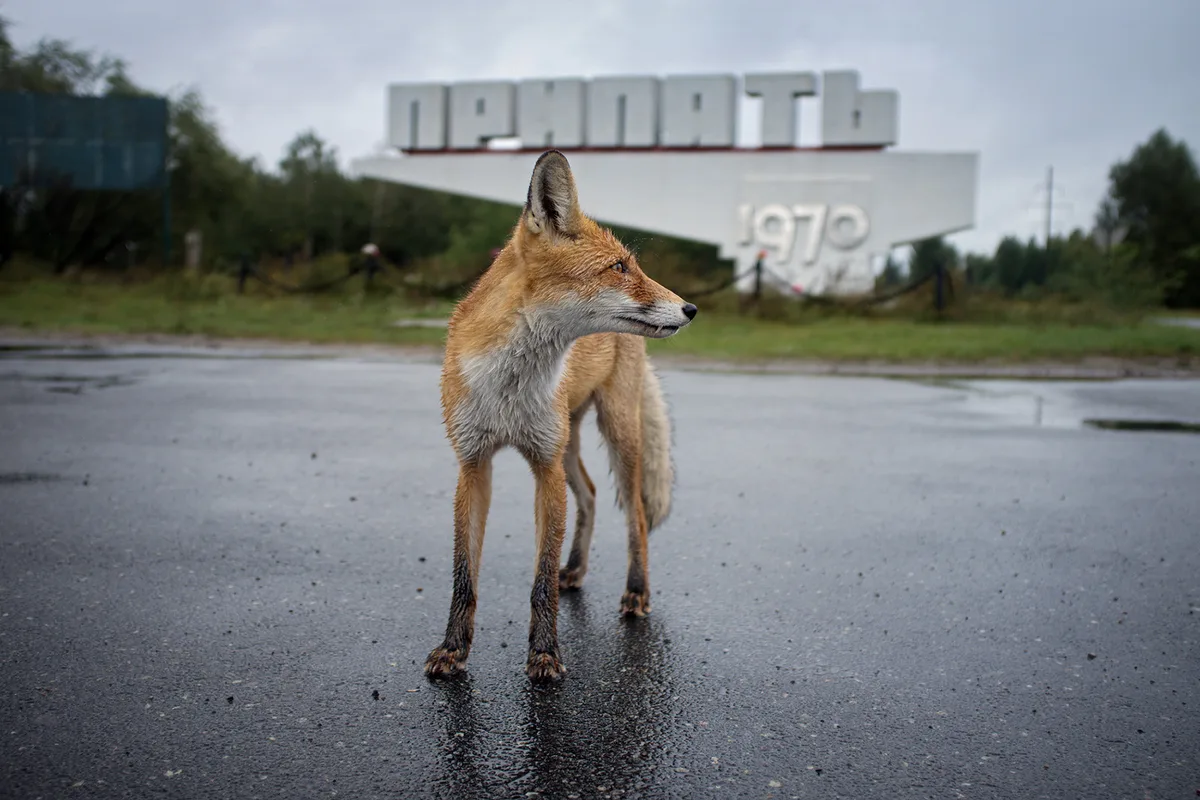
On the other hand, Chornobyl has also become a positive example of how nature can recover, whether from a man-made disaster or war. Left undisturbed, ecosystems recover quickly, and today the Chornobyl Exclusion Zone—the area most affected by contamination as a result of the 1986 disaster—is considered by environmental experts to be one of the most striking examples of biodiversity development.
History of the Chornobyl disaster
On the night of April 26, 1986, an accident occurred at the Chornobyl Nuclear Power Plant—two powerful explosions at the reactor Unit Four, resulting in a fire that lasted ten days. This resulted in a radiation release of approximately 5,200 petabecquerels (PBq) in Iodine-131 equivalent (of which Iodine-131 accounted for about 1,760 PBq and Cesium-131 for approximately 85 PBq). By comparison, the Fukushima accident in Japan resulted in a release of 340–708 PBq in Iodine-131 equivalent. The Kyshtym (Mayak) disaster in Russia’s Eastern Urals in 1957 released 74–80 PBq, and the Windscale accident in northwest England released 0.75 PBq.
As a result of the disaster, territories in Belarus, Ukraine and Russia were contaminated with radioactive substances. Although Russia suffered the most widespread contamination—approximately 49,800 square kilometers of land (with the most dangerous contamination zone spanning 300 square kilometers, where the radiation background exceeds 1,480 kBq/m³), the largest amount of radioactive material fell in Belarus—2,200 square kilometers in a highly hazardous zone—and in Ukraine—600 square kilometers. In effect, these areas have become exclusion zones where it is impossible to live, engage in agricultural activities, or develop infrastructure. The only activity possible here is research into how nature responds to radiation and recovers without human intervention.
Nature reserves were established to study the radiation’s environmental impacts. The first was the Polesia State Radiation Ecological Reserve (PSRER), established in 1988 in Belarus, the country most affected by the Chornobyl disaster. In Ukraine, where Chornobyl is located, the exclusion zone has existed since 1986. In addition, the Chornobyl Radiation and Ecological Reserve (CRER) was established relatively recently in 2016, replacing a previous Chornobyl Wildlife Refuge that had existed there since 2007. However, while the PSRER in Belarus was originally under the jurisdiction of the Ministry of Emergency Situations (MChS) and was only transferred to the Ministry of Natural Resources and Environmental Protection relatively late (in 2023), the CRER was immediately developed as a nature conservation project open to research. This did, however, have some negative side effects—special tours for tourists were organized to the Chornobyl zone, and uncontrolled “stalking” (trespassing in the zone) became widespread. This often led to forest fires.
Chornobyl during Russia’s full-scale invasion
After the start of the full-scale invasion, Chornobyl and the Exclusion Zone were captured almost immediately by Russian troops, who entered from Belarus. Chornobyl, the Chornobyl Exclusion Zone, and Slavutych—a single-industry town where most of the population once worked at the Chornobyl Nuclear Power Plant—were under occupation from February 24 to May 2, when the Armed Forces of Ukraine (AFU) reclaimed these territories without a fight.
After the de-occupation of Chornobyl, studies were conducted on the impact of that occupation in the exclusion zone, carried out by both the International Atomic Energy Agency (IAEA) and independent expert groups. For example, a 2025 study conducted by Greenpeace Germany showed that radiation levels in the Chornobyl zone, where combat operations took place or Russian troops were stationed, are three times higher than the figures cited earlier by the IAEA. For example, near Yanov station, where a Russian military camp was located, the Greenpeace team recorded radiation dose rates ranging from 0.18 μSv/h (microsieverts per hour) to 2.5 μSv/h at a height of 10 cm. At a crossroads 1.5 km from a de-occupied Russian checkpoint and near the Red Forest, the radiation dose rate was 7.7 μSv/h. Research by Greenpeace Germany confirmed that Russian troops were not only present in areas with high levels of radioactive contamination, but also stirred up radioactive dust through their actions, including building fortifications and moving heavy equipment. What struck the public and experts most was that Russian soldiers had set up a post in the most contaminated part of the Chornobyl zone—the Red Forest. This was highly likely to cause radiation sickness and increase cancer risk. Some Ukrainian media outlets even reported that all the soldiers who participated in the construction of fortifications in the Red Forest subsequently died. However, UWEC Work Group was unable to verify this information.
All research stations and all infrastructure built in the Chornobyl zone were looted and destroyed. Vladimir Verbitsky, Chornobyl “liquidator” and lead Ukrainian engineer responsible for accompanying official delegations, told BBC Ukraine that: “The Russians looted all checkpoints, monitoring centers in the exclusion zone, laboratories, and everything else where there was any equipment.” They dismantled the equipment for scrap metal and tossed debris in the bushes. Scientific research that had been conducted in the zone for decades suffered colossal damage.
However, military intervention in the Chornobyl zone did not end after de-occupation. On February 4, 2025, a Russian Shahed-136 drone struck the new containment structure of the fourth reactor unit—the very one that exploded in 1986 and led to the radiation release. The waterproof membrane continued to smolder for three weeks. Fortunately, there was no new radiation release, but the containment structure sustained serious damage.
A study by Greenpeace Ukraine in 2025 (following its third expedition to the Chornobyl zone since the start of the full-scale invasion) showed that the structure is in critical condition. As Sean Burnie, a nuclear safety expert at Greenpeace Ukraine, noted in April 2026, the containment structure requires urgent repairs, or it could collapse. Sergey Tarakanov, director of State Specialised Enterprise Chornobyl Nuclear Power Plant (CNPP), also confirmed that the sarcophagus had lost its sealing properties. However, according to him, if the systems are functioning normally, the likelihood of a radiation leak is low. On January 20, 2026, CNPP lost its external power supply as a result of another attack by Russian drones, as reported to the IAEA. Russian strikes on Ukraine’s power grid continue, and Chornobyl remains a ticking time bomb.
Unforeseen consequences of the Russian invasion for Chornobyl
As noted above, the areas most affected by the Chornobyl disaster are located in two countries—Belarus and Ukraine. Research is critical to understanding how nature adapts to the consequences of man-made disasters, and in this case, it must be conducted in both countries. And for a long time, this was the case. However, the political protests in Belarus in 2020 were followed by civil society repressions that also affected the environmental community. In particular, many environmental organizations were shut down, including APB (“Akhova Ptušak Batskavčyny” — “Protection of the Birds of the Homeland”) and Ecohome. As a result, Belarusian participation in cross-border projects, such as Polissya: Wildlife Without Borders, was suspended.
Following Russia’s military invasion via Belarus and then their de-occupation of northern Ukraine, the Ukrainian government decided to establish a militarized zone along the border. Specifically, certain areas are to be removed from the country’s nature reserve fund and transferred to the State Border Guard Service. This will affect quite a few protected areas, including those lands listed in Europe’s Emerald Network, as well as the Chornobyl Radiation and Ecological Reserve. This decision will remain in effect during martial law and for another year thereafter. In other words, neither research nor conservation work will be possible in these areas. As noted by Oleksiy Vasyliuk, head of the Ukrainian Nature Conservation Group and a UWEC Work Group expert, this approach will not only complicate the protection of wildlife in the border zone but also make Ukraine’s fulfillment of its international environmental and climate commitments more challenging. As an alternative, Vasyliuk proposes leveraging the functional defensive potential of wildlife—preserving wetlands and forests—to make border territories more difficult to penetrate in the event of a renewed invasion from Belarus.
Read more: Protected areas and border zones in Ukraine: How to harmonize them?
Fires in the Exclusion Zone have always been dangerous due to the risk of radiation spread, and in recent years a new source of fires has emerged—war. Russian drones crash in Chornobyl forests and spark fires and Russian and Belarusian saboteurs deliberately start fires across the border.
Funding is needed to resume research work in the Chornobyl zone. French experts have estimated the cost of restoring a single containment structure at 500 million euros. This does not include the costs of building new laboratories and infrastructure and conducting new research on the impacts of the military occupation on the Chornobyl zone. All these projects are high-priority—if the sarcophagus is not restored, a new Chornobyl disaster looms. If the research is abandoned, forty years of data and knowledge will be lost. All of this is a consequence of Russia’s invasion of Ukraine.
How does wildlife adapt to a man-made disaster? Can the experience with Chornobyl help in the reconstruction of Ukraine?
Although the radiation contamination resulted from a man-made disaster, the Chornobyl Exclusion Zone has a silver lining—seeing what happens to wildlife free of human interference. For decades now, the Polesia State Radiation-Ecological Reserve and Chornobyl Exclusion Zone have been recording active recovery of wildlife populations; rare species such as the European lynx and European bison have returned. The introduction of certain species, such as Przewalski’s horse, has also been successful. Furthermore, the natural restoration of wetland areas has created optimal conditions for the recovery of the greater spotted eagle (Clanga clanga) population.
Much has been said—and continues to be said—about the restoration of wildlife in the Chornobyl zone. British author I. J. Swift’s novel When the Wolves Return was inspired by returning wildlife in the Chornobyl zone and was named best novel by the British Science Fiction Association in 2025.
Of course, not everything there is so rosy for nature. Mutations and anomalies caused by radiation contamination have been observed, in particular color changes for some amphibians. A biologist at the University of South Carolina, Dr. Timothy A. Musso writes that radiation has provoked mutations that caused a decline in the populations of barn swallow (Hirundo rustica), icterine warbler (Hippolais icterina) and blackcap (Sylvia atricapilla). Many animals develop cataracts and cancer as a result of radiation, and their brain size shrinks. Nevertheless, the Chornobyl Exclusion Zone remains an example of nature’s adaptation to man-made disasters and offers hope that recovery can proceed even more successfully in areas free of radiation contamination.
The experience of the Chornobyl forests offers a clue as to what to do with the conflict battle lines where conflict has raged since 2022. Constant fighting, minefields and pollution from drone warfare have led to severe contamination raise a valid question—should nature be left to restore itself? Ten years down the road natural forests and steppes could be regrowing in the Donetsk and Luhansk regions. At the very least, the Great Meadow Velyky Luh, now regrowing on the site of the Kakhovka Reservoir, has clearly demonstrated that nature is its own post-human clean-up crew after yet another man-made disaster.
Forty years on, the shadow of Chornobyl still hangs over Ukraine, Belarus and Russia. Sometimes it seems like metastases or a terrible curse, reminding us that the danger of a nuclear disaster is always nearby. Shelling of the Zaporizhzhya Nuclear Power Plant to the south of Chornobyl continues, and drones and missiles soar overhead at the South Ukraine Nuclear Power Plant. All of this has reignited people’s fear of a new nuclear disaster, a fear that began to subside a decade ago but has now resurfaced as a stark reminder that “safe” nuclear power can be dangerous. Chornobyl’s nuclear threat remains, posing the greatest danger not so much to nature but to humans.
Translated by Jennifer Castner
Main image source: BBC Science Focus Magazine