
The French media La Libre spoke with UWEC co-founder Oleksiy Vasilyuk about a balance between safe mine clearance, ecosystem protection, and future recovery of Ukraine. We’ve translated this material for you.
Anti-personnel mines, cluster munitions, and other explosive remnants of war not only cause human casualties but can also contaminate land and groundwater by releasing metals and toxic substances.
As long as hostilities continue, it is difficult to fully assess the environmental damage caused by mines and unexploded ordnance, emphasizes Oleksiy Vasyliuk, a zoologist and UWEC Work Group expert. “Unlike fires or floods, which can be studied remotely using satellite images taken before and after events, contamination from explosive materials—shells, mines, rockets—is much harder to measure from space. Researchers need to be on location.” Scientists must collect soil samples following a very strict protocol. “We must remember that the most heavily affected areas along the frontline are inaccessible.”
“Of course, there are liberated territories, but they are not as heavily contaminated with explosives. In addition, while some chemicals may remain in one area for a very long time, others can migrate, for example, into groundwater. If we demined these areas thirty years later, how would we study the impact of substances that had already disappeared? It is impossible to obtain a fully reliable assessment of contamination. Today our task is to prepare solutions for the post-war future of the most affected territories,” explains Vasyliuk.
Territories similar to Chernobyl
Vasyliuk, who specializes in studying the distribution of rare animal species, has not been able to conduct his usual research since the invasion began in 2022. Today, in his role as leader of the Ukrainian Nature Conservation Group, he mainly works with GRIT (Ground Rehabilitation through Innovation Technologies), a digital humanitarian demining platform used by the Government of Ukraine. In addition to socio-economic criteria, the platform also incorporates environmental considerations.
“After the war, many countries will want to help us rebuild the country. Thanks to this support, some areas may be quickly demined, but others may never be cleared because resources will eventually run out. Therefore, we must invest where recovery will be most meaningful. Other uncleared areas will likely remain closed to people, similar to the Chernobyl Exclusion Zone. They could become vast natural areas where mines and munitions remain deeply buried underground – heavily contaminated territories, yet rich in wildlife. But this could also lead to the collapse of our agriculture sector and industry if areas can not be restored to usable condition,” he noted.
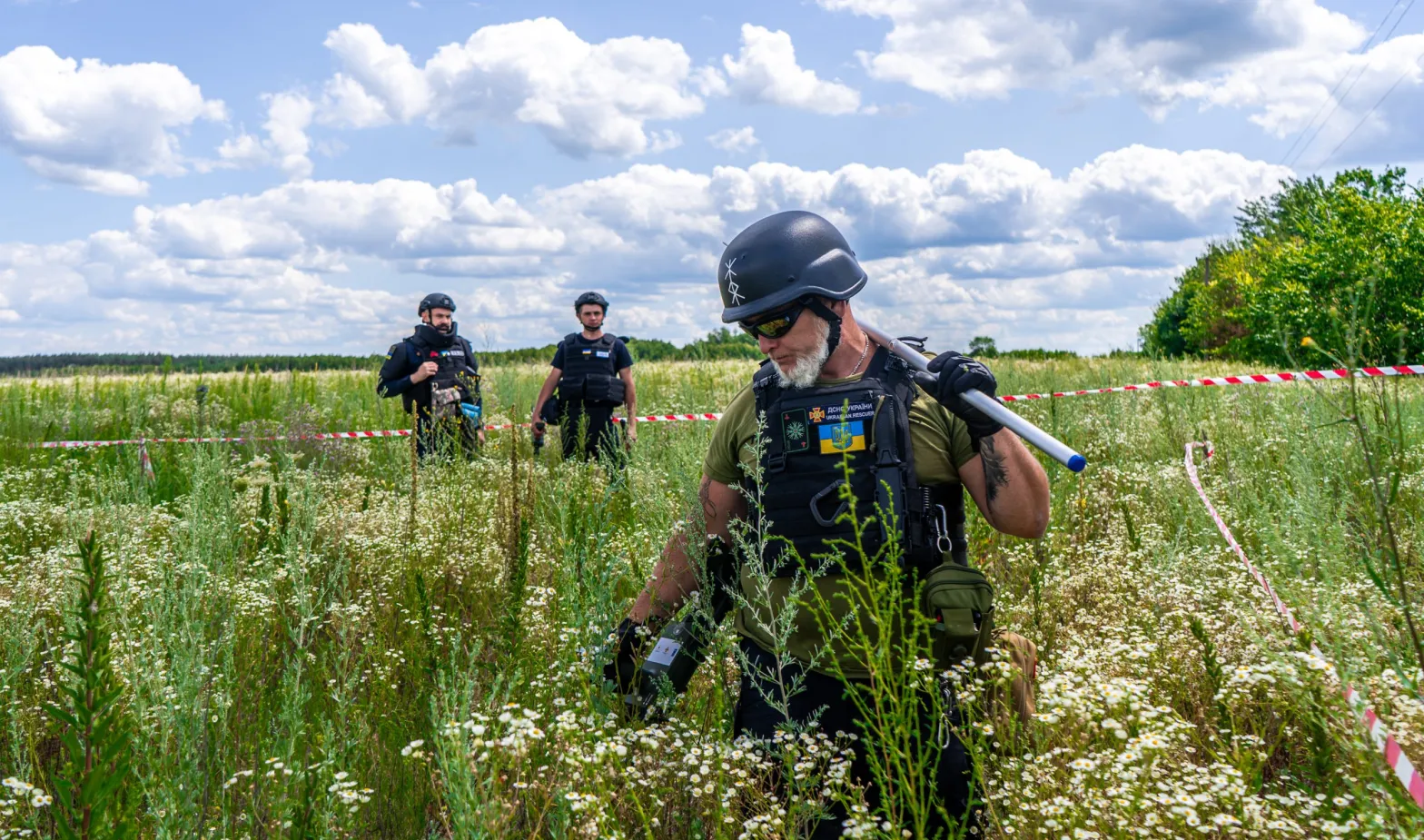
When demining has negative impacts
These territories will remain uninhabitable because of the inherent danger and because the soil may gradually become contaminated and unsuitable for agriculture. According to a CEOBS report, most munitions contain heavy metals and toxic explosive substances such as arsenic, chromium, and copper. Their internal compounds are often linked to explosives such as TNT, HMX, and RDX – nitrogen-containing compounds that rapidly turn into gas when ignited. These explosives vary in toxicity for humans and living organisms, and their behavior in the environment also differs.
“Unexploded mines become dangerous for nature when they begin to degrade. But all shells, mines, rockets, and kamikaze drones are filled with chemicals enclosed in metal casings, and once they explode, these substances are released into the environment. That is why I oppose mechanized demining, which involves detonating mines with machines. It contaminates the soil, and afterward nothing can be grown there. It also encourages highly invasive and pollution-resistant plants such as acacias, which begin to displace native species,“ Vasyliuk explains.
A study published in Springer Nature Link and conducted in two vulnerable areas of the Halgurd-Sakran National Park in Iraqi Kurdistan found that explosions associated with demining heavily contaminated soils with heavy metals, particularly nickel and chromium. This pollution poses heightened risks for agriculture and consequently for the food chain and human health.
Thus, the dilemma between the safety and speed of mechanized demining lies primarily in its environmental impact. “In all other situations, we would prefer to avoid mechanized demining. But if we do not use it, manual demining takes much longer and increases risks for sappers. So we must evaluate the balance between risk and benefit,” explains Olena Pareniuk, head of the GRIT platform.
Do not forget about nests
To preserve the environment as much as possible, Pareniuk and Vasyliuk are working together to study the impact of demining on wildlife and vegetation. “We are seeking funding to support Vasyliuk and his team to collect information about endangered species; this will be the first project of its kind. We have environmental standards for demining. For example, they state that areas containing nests should not be cleared during nesting season. But sappers do not know where these nests are located. Until now, this environmental standard was only a theoretical document that was difficult to implement. Thanks to our collaboration with Vasyliuk, we can now map these territories and indicate the presence of nests or endangered plants. Sappers will then be able to identify sensitive areas and, for example, prohibit demining during the vegetation period,” explains Pareniuk.
Vasyliuk expressed satisfaction with the cooperation: “We want certain territories to receive protected legal status and never be mechanically demined under any circumstances. The same applies to areas inhabited by rare species of plants and animals. These are fundamental principles.”
As for rivers and the Black Sea, the zoologist is somewhat less concerned: “All rivers flow into the sea, which will therefore also become contaminated. But I do not think this will become a major catastrophe. At present no one can estimate the scale of pollution, but I believe it will occur gradually and therefore remain barely noticeable. The Black Sea is a special case: life exists only in the upper layers of its waters. Below that, the chemical composition of the water is such that almost no life exists there. Most chemical substances settle in the lower layers, where life is already absent. Of course, this is also a problem, but not the most urgent one.”
Ecocide?
Beginning in the first months of Russia’s invasion of Ukraine, the term “ecocide” resurfaced, and some have called for its recognition by the International Criminal Court alongside genocide and crimes against humanity. In April 2022, Ukrainian President Volodymyr Zelenskyy publicly accused Russia of committing “ecocide” because of environmental destruction caused by bombings, forest fires, soil and water contamination, and nuclear threats.

Vasyliuk notes,“In Ukraine, the word ‘ecocide’ now has real legal meaning, but many people use it incorrectly. The use of mines, however harmful and dangerous, does not mean the destruction of all life. For example, if territories are mined but abandoned by people, wildlife may actually thrive there.”
“A more concrete example of ecocide is the destruction of the Kakhovka Dam. All living organisms there were swept into the sea and died. Those that lived on the bottom of the Dnipro remained on land and died. Everything within the flooded zone was also washed away. Even much of the sea, precisely at the moment when marine organisms were reproducing, was polluted by the massive inflow of freshwater, leading to mass mortality. I do not know another example of such large-scale extinction of living organisms,” says Vasyliuk.
For Pareniuk, the issue is framed differently. “One avenue on the GRIT platform is collecting evidence of this ecocide so that it can be documented. There are no international standards clearly defining ecocide. It is a scientific term, but how do we provide proof? Therefore, our work involves gathering and documenting evidence, and the impact of mines, shells, and munitions is part of this process. But obviously many problems will only truly be resolved once Russia ends its invasion of Ukraine.”
Recent posts:
- UWEC Work Group designated an “undesirable organization” in Russia
- Wild Victims of War. Great Crested Grebe (Podiceps cristatus)
- A Review: “Russian civil society under repression”
- Ten years of sea arbitration—limited gains for Ukraine, a step forward for environmental law
- Environmental consequences of the war in Ukraine: June 2026 review